
Celebrating a Century of Quantum Science: SISC Special Section on Quantum Computing
Over the last decades, quantum computing has evolved from a speculative idea into a rapidly advancing scientific and technological discipline. Qubit counts have surpassed the thousand-qubit mark, researchers have demonstrated early fault-tolerant logical qubits, and multiple competing hardware platforms now appear on commercial vendor roadmaps. These developments are accompanied by corresponding advances in quantum algorithms and software frameworks that test, benchmark, and scale quantum capabilities.
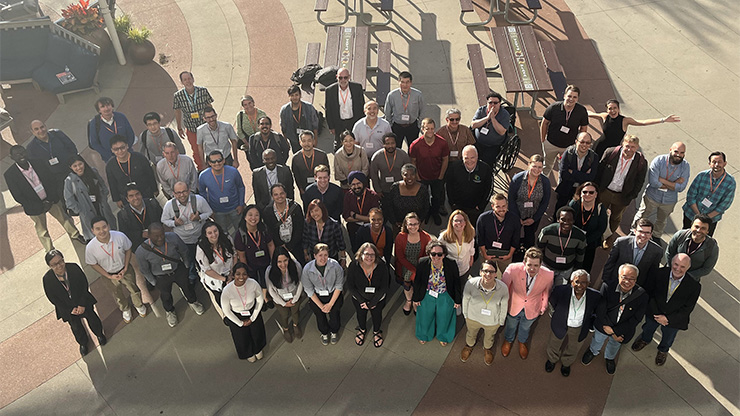
At the same time, the mathematics and scientific computing communities are actively working to shape the intellectual foundations of this emerging field [4]. SIAM has been central to this momentum, having recently hosted the three-day SIAM Quantum Intersections Convening, which took place in Tysons, Va., in October 2024 and brought together leaders from numerical linear algebra, computational science, optimization, quantum information, and high-performance computing to discuss developments in quantum computing [6]. This interactive workshop sought to increase the involvement and visibility of mathematicians and statisticians in the quantum realm.
Prior to the convening, SIAM News published a two-part special issue on quantum computing—spearheaded by David Hyde of Vanderbilt University and Alex Pothen of Purdue University—that included seven total articles from experts in the field [2, 3]. The articles are part of SIAM News’ larger collection of quantum computing material and addressed a variety of topics, from the fundamentals of quantum computing and its interplay with machine learning to the importance of end-to-end complexity for quantum algorithms and the challenges that accompany noisy intermediate-scale quantum (NISQ) devices.
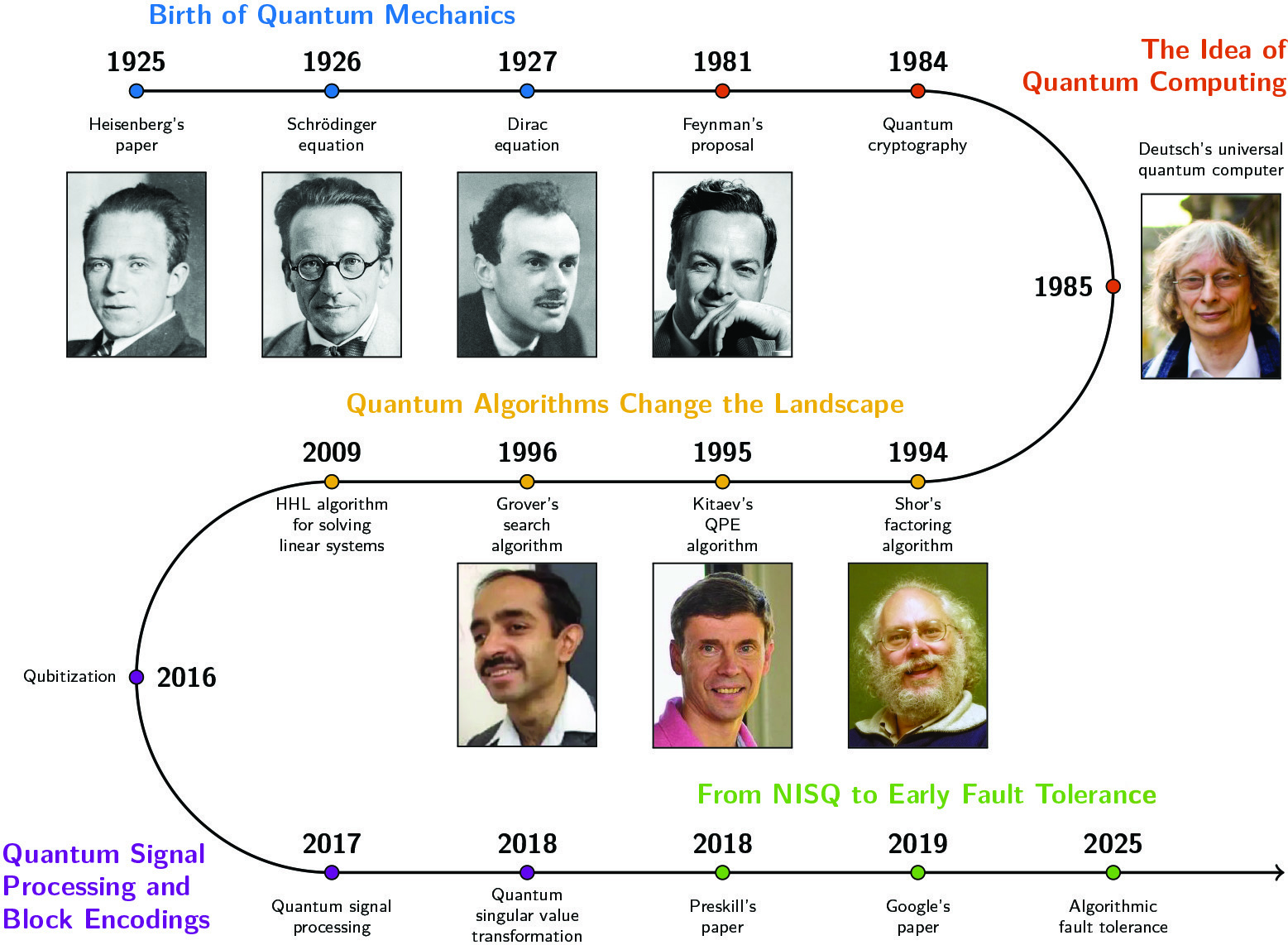
These collective efforts preceded a broader global moment: the United Nations’ designation of 2025 as the International Year of Quantum Science and Technology (IYQ). This distinction celebrated the centennial of the development of modern quantum mechanics that started with physicist Werner Heisenberg’s seminal 1925 paper titled “On the Quantum-theoretical Reinterpretation of Kinematical and Mechanical Relationships,” which is commonly known as the “Umdeutung” (reinterpretation) paper [1]. Generally speaking, the development of quantum computing can be organized into five broad periods (see Figure 1):
- Birth of quantum mechanics (1925-1930)
- The idea of quantum computing (1981-1985)
- Quantum algorithms that change the landscape (1990s-2000s)
- Quantum signal processing and block encodings (2016-2018)
- From NISQ to early fault tolerance (2018-present).
Special Section on Quantum Computing
To help consolidate and elevate this growing body of research, a Special Section of the SIAM Journal on Scientific Computing (SISC) on “Quantum Computing: Numerical Algorithms and Applications” is accepting submissions until April 30, 2026. The section aims to serve as a central venue for rigorous, reproducible, and practically relevant research at the interface of quantum and scientific computing. The review process for each manuscript will begin immediately after submission, and papers will be published online on a rolling basis shortly after their acceptance.
The scope of this Special Section is broad. The first focus area is “Quantum Algorithms for Scientific Computing Applications,” which encompasses subjects like quantum algorithms for the solution of differential equations, linear and nonlinear systems, eigenvalue problems, preconditioning, optimization, and machine learning. Applications may include fluid mechanics; solid mechanics; physics; materials science; and other areas of science, engineering, and technology. The second area of focus is “Scientific Computing Methods for Quantum Computing Science,” which will explore topics such as tensor network representations to speed up quantum computing simulators, numerical methods to model physical qubits and quantum processors, and numerical optimal control methods for the design of quantum gates and pulse shapes.
![<strong>Figure 2.</strong> Block-encoding circuit for an \(8\times 8\) Toeplitz matrix that can serve as a building block in a quantum algorithm to solve partial differential equations on a gate-based quantum computer via finite difference methods. Figure courtesy of [5].](/media/0ioppxsi/figure2.jpg)
Submissions to the SISC Special Section should present algorithmic contributions in the context of a full algorithmic stack that advances end-to-end quantum applications, rather than focusing on some core components of quantum algorithms in isolation. This specification includes concrete approaches for the two demanding steps to prepare the initial quantum state prior to computation (i.e., the state preparation problem) and extract the result after computation (i.e., the state readout problem). The section’s overall scope includes various quantum computing technologies, such as gate-based quantum computers (see Figure 2), quantum annealers, and hybrid quantum-classical approaches. Evaluation of the proposed numerical algorithms for computational experiments—in either simulation environments or on actual quantum hardware—is a mandatory requirement of all submissions, as is comparison to best-in-class alternatives.
The Special Section’s longer-term goal is to position SISC as a prominent outlet in the SIAM journal ecosystem for high-quality research results on quantum algorithms for scientific computing applications, as well as scientific computing approaches for quantum computing science.
The Quest for Practical Quantum Advantage
Quantum advantage—a quantum computer’s achievement of computational performance that is unobtainable on classical hardware—remains a widely discussed goal in both academia and industry. Proof-of-principle algorithms have been proposed, and vendor roadmaps outline increasingly ambitious fault tolerance milestones. Nevertheless, many challenges remain. Current devices face strict coherence limits, severe circuit-depth constraints, and non-negligible error rates. Even as hardware continues to improve, the translation of asymptotic algorithmic speedups into practical advantage requires careful analysis, sophisticated numerical techniques, and the scrutiny of an applied mathematics community that is experienced in connecting theory and computation.
SIAM is poised to lead these developments, as both the aforementioned SIAM Quantum Intersections Convening and IYQ 2025 underscored the need to strengthen mathematical foundations as quantum technologies mature. With the rapid spread of quantum-related conferences and preprints, the literature has become highly fragmented across physics, engineering, and computer science journals. Many papers omit crucial algorithmic components, such as state preparation strategies, full resource estimates, numerical validation, or explicit circuit constructions. Others introduce abstract oracles but fail to show whether they can be made practical on hardware.
As a society for industrial and applied mathematics with more than 14,000 members around the world, SIAM is uniquely positioned to foster the creation of an international community of mathematicians and domain experts to fill this knowledge gap. The SISC Special Section is a strong step in this direction. SIAM has successfully established bridges between mathematical theory and real-world applications in science, engineering, and industry for more than 70 years, and we hope that this Special Section will help to extend the story from scientific computing to scientific quantum computing — creating a much-needed, dedicated space at the intersection of applied mathematics and quantum computing.
An Exciting Path Forward
An ever-growing list of international conferences and workshops include quantum algorithms for scientific computing as part of their programs. What began as isolated minisymposia sessions has evolved into a sustained, multi-conference presence across the computational science landscape. Recent years have seen quantum-focused sessions—and in some cases, entire thematic tracks—throughout a broad range of SIAM and non-SIAM conferences, including the 2024 SIAM Conference on Applied Linear Algebra, 2025 SIAM Conference on Computational Science and Engineering, 39th IEEE International Parallel and Distributed Processing Symposium (IPDPS 2025), 26th Conference of the International Linear Algebra Society (ILAS 2025), and 15th International Conference on Spectral and High Order Methods.
The first-ever thematic conference that was fully dedicated to quantum algorithms in computational science and engineering took place in October in Aachen, Germany. This meeting, titled the 1st International Conference on Applied Quantum Methods in Computational Science and Engineering (AQMCSE 2025), was organized by the European Community on Computational Methods in Applied Sciences. AQMCSE 2025 and the aforementioned events demonstrated both the breadth of relevant problems—e.g., linear solvers, eigenvalue estimation, partial differential equations, optimal control, drug discovery, and computational mechanics—and the diversity of algorithmic techniques, from quantum singular value transformation to hybrid quantum-classical Krylov methods.
Looking ahead, the field of quantum numerical methods is gaining additional visibility: ILAS 2026 in May will include invited minisymposia about quantum numerical linear algebra, IPDPS 2026 in May will continue its trajectory of crossover research between quantum and high-performance computing, and AQMCSE 2026 in September will mark the second installment of the new conference series on quantum methods. Additionally, quantum algorithms will likely feature prominently at the 17th World Congress on Computational Mechanics, which will take place in July. Across these meetings, the trend is clear: quantum algorithms for scientific computing are no longer peripheral — they are rapidly becoming a sustained area of research activity.
Want to contribute to this growing area of research? The SISC Special Section on “Quantum Computing: Numerical Algorithms and Applications” is accepting submissions until April 30, 2026. Interested authors should submit a manuscript and cover letter in PDF format to SISC’s online submission site. Please contact SIAM Publications Manager Heather Blythe at HBlythe@siam.org with any questions.
References
[1] Heisenberg, W. (1925). On the quantum-theoretical reinterpretation of kinematical and mechanical relationships. Zeit. Phys., 33, 879-893.
[2] Hyde, D., & Pothen, A. (2024, April 1). An introduction to quantum computing and applied mathematics. SIAM News, 57(3), p. 2.
[3] Hyde, D., & Pothen, A. (2024, May 1). Introducing part II of the special issue on quantum computing. SIAM News, 57(4), p. 3.
[4] Nannicini, G. (2020). An introduction to quantum computing, without the physics. SIAM Rev., 62(4), 936-981.
[5] Patel, V.N. (2025). Quantum algorithms for PDEs via summation-by-parts discretisations [Master’s thesis, University of Waterloo]. UWSpace.
[6] Society for Industrial and Applied Mathematics. (2025). Report of the SIAM quantum intersections convening: Integrating mathematical scientists into quantum research. Philadelphia, PA: Society for Industrial and Applied Mathematics. Retrieved from https://www.siam.org/media/orydkrzd/quantum-convening-report.pdf.
About the Authors
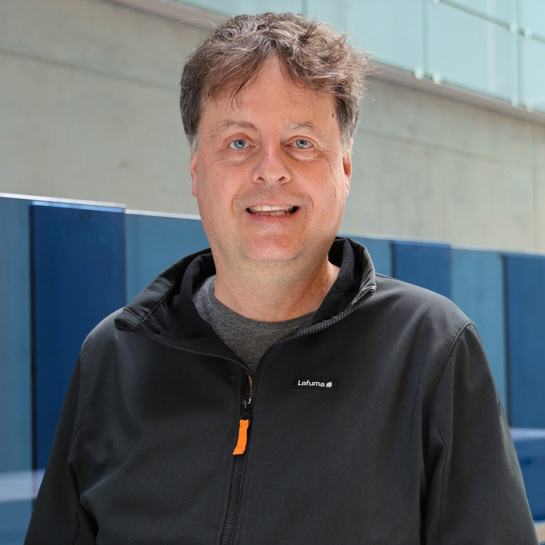
Hans De Sterck
Professor, University of Waterloo
Hans De Sterck is a professor of applied and computational mathematics at the University of Waterloo in Canada. He is editor-in-chief of the SIAM Journal on Scientific Computing.
Matthias Möller
Associate professor, Delft University of Technology
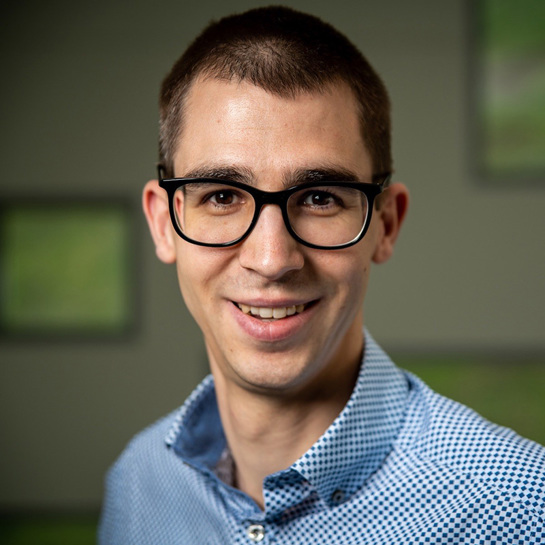
Matthias Möller is an associate professor of numerical analysis at Delft University of Technology in the Netherlands. He is co-editor-in-charge of the SIAM Journal on Scientific Computing’s Special Section on “Quantum Computing: Numerical Algorithms and Applications.”

Roel Van Beeumen
Staff scientist, Lawrence Berkeley National Laboratory
Roel Van Beeumen is a staff scientist at Lawrence Berkeley National Laboratory and a professor of computer science at KU Leuven in Belgium. He is co-editor-in-charge of the SIAM Journal on Scientific Computing Special Section on “Quantum Computing: Numerical Algorithms and Applications.”


Stay Up-to-Date with Email Alerts
Sign up for our monthly newsletter and emails about other topics of your choosing.