
Introducing the 2025-2026 SIAM Project NExT Fellows
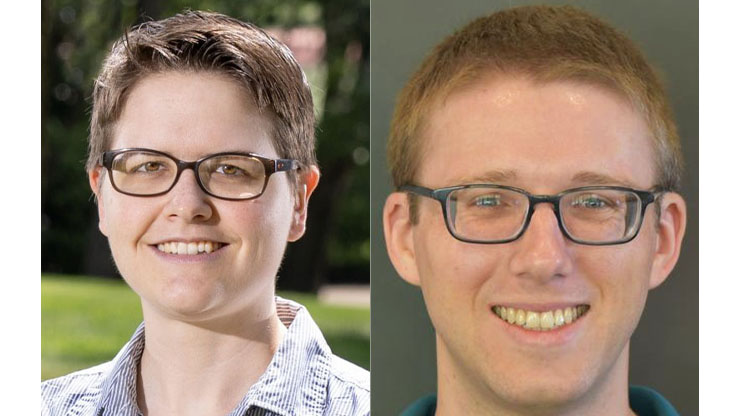
SIAM routinely supports the professional development of junior faculty members and recent Ph.D. graduates in multiple ways. For example, the SIAM Activity Group on Applied Mathematics Education furthers the advancement of educational programs, courses, and resources in applied math to better serve its academic members. SIAM also promotes the occupational growth of early-career scientists through its annual sponsorship of two Mathematical Association of America (MAA) Project NExT (New Experiences in Teaching) Fellows. The Society is proud to announce that Matt Dallas of the University of Dallas and Rafael Ceja Ayala of Arizona State University (ASU) have been selected as the 2025-2026 SIAM Project NExT Fellows. Congratulations to these accomplished early-career mathematicians!
Project NExT is a professional development program of the MAA for new or recent Ph.D.s in the mathematical sciences that “addresses all aspects of an academic career: improving the teaching and learning of mathematics, engaging in research and scholarship, finding exciting and interesting service opportunities, and participating in professional activities.”
The yearlong program aims to provide junior faculty in postsecondary environments with workshop access, opportunities to build a peer network, and connections with mentors who can share valuable career guidance. Project NExT Fellows ultimately learn better strategies for engaging and supporting a wide range of students, involving students in mathematics research projects, preparing future teachers for the K-12 mathematics classroom, and balancing teaching and research obligations at academic institutions.
To facilitate this evolutionary journey, SIAM offers multiple opportunities for its Fellows to participate in SIAM activities and expand their professional networks. Previous SIAM Project NExT Fellows have served on the SIAM Education Committee, organized SIAM-sponsored sessions at the Joint Mathematics Meetings (JMM) and MAA Mathfest, helped to plan and execute “Student Days” events at the SIAM Annual Meeting, developed and managed SIAM outreach events, and organized minisymposia and panels at SIAM conferences.
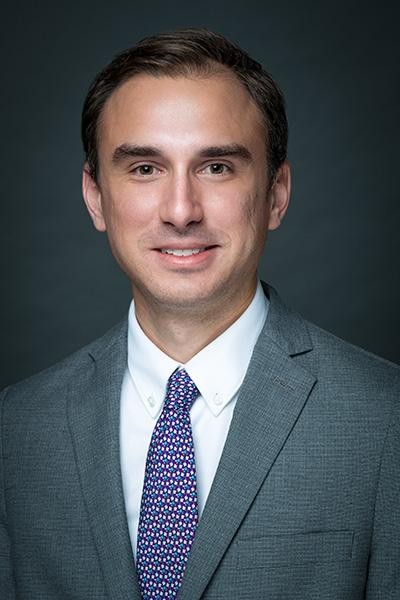
SIAM 2025-2026 Project NExT Fellow Matt Dallas is a postdoctoral instructor of mathematics in the Department of Mathematics at the University of Dallas. He received his Ph.D. in mathematics from the University of Florida in 2024, and his research interests are in numerical analysis — with a particular focus on nonlinear solvers and Anderson acceleration extrapolation schemes. Dallas’ recent work considers novel applications for problems in fluid mechanics and the development of Anderson acceleration theory in the context of a broad class of solvers, including the well-known Levenberg-Marquardt method.
Beyond his personal research pursuits, Dallas is passionate about teaching and strives to create positive, interactive mathematical experiences for his students. At the University of Dallas, he has guided student projects on novel applications of Anderson acceleration and has been experimenting with inquiry-based learning, alternative assessment, and teaching with primary historical sources; he even contributed to a study about student experiences with these sources. Dallas also co-organized a session at JMM 2026, which took place in January in Washington, D.C., on “Perspectives on Implementing Alternative Grading” with members of his Project NExT cohort.
In August 2026, Dallas will join the Department of Mathematics at Transylvania University as an assistant professor. He is excited to further develop his research, mentor undergraduate projects in numerical analysis, and continue his work with alternative assessment and active learning practices. Besides math, Dallas enjoys reading, backpacking—particularly on the Appalachian Trail—visiting national parks, and spending time with his family.

Rafael Ceja Ayala, the other 2025-2026 SIAM Project NExT Fellow, is a Presidential Postdoctoral Fellow in the School of Mathematical and Statistical Sciences at ASU. He earned his Ph.D. in applied mathematics at Purdue University, where his doctoral research explored inverse scattering problems with conductive boundaries — a topic that he continues to investigate at ASU. Ceja Ayala studies direct and inverse problems for partial differential equations, and his work connects deep mathematical theory with real-world applications in imaging, nondestructive testing, and the detection of hidden structures in complex materials. He develops rigorous yet computationally efficient methods for inverse scattering and electrical impedance tomography and contributes to the growing theory of transmission eigenvalues: wavenumbers that offer insight into the movement of waves through different media.
Throughout his early career, Ceja Ayala has been an active and involved member of the applied mathematics community. He has presented at major SIAM conferences, organized several minisymposia, participated in and wrote about a 2024 workshop on “Empowering a Diverse Computational Mathematics Research Community” (hosted by the Institute for Computational and Experimental Research in Mathematics and run in collaboration with SIAM), and served as a Guided Affinity Group leader for the Sustainable Horizons Institute’s Building Engagement program at the 2025 SIAM Conference on Computational Science and Engineering. In 2025, Ceja Ayala received the MGB-SIAM Early Career Fellowship.
Ceja Ayala is equally committed to mentorship and inclusion in mathematics education. At both Purdue and ASU, he taught a variety of courses, co-organized graduate seminars, and mentored students through honors theses, summer research opportunities, and national programs. He strives to create learning environments that emphasize curiosity, belonging, and creativity while showing students the myriad ways in which mathematics can illuminate the world around them. As Ceja Ayala continues his postdoctoral work at ASU, he remains dedicated to advancing research in inverse problems, building collaborative research networks, and supporting the next generation of mathematical scientists.
Outside of work, Ceja Ayala enjoys hiking, biking, running, and spending time outdoors. He is also passionate about photography and creative writing, which allow him to explore the world from different perspectives.
Junior SIAM members who are pursuing academic careers should consider applying for the Project NExT program. Interested parties must complete the application form and submit a personal statement, research statement, one-page curriculum vitae, and letter of support from their department chair. Eligible candidates should hold a recent Ph.D. in mathematics, statistics, mathematics education, or another math-intensive field; maintain a current teaching position; and have experiences, attitudes, ideas, and leadership abilities that would contribute to the cohort. To be considered for SIAM sponsorship, applicants must note their SIAM membership on their application. An MAA committee selects all Project NExT Fellows. Visit the Project NExT website for additional details and apply before the next deadline of April 15, 2026.
About the Authors
Lea Jenkins
Professor, Clemson University
Lea Jenkins is a professor in the School of Mathematical and Statistical Sciences at Clemson University, where she works on modeling and simulation problems with industrial applications. She holds a Ph.D. in mathematics from North Carolina State University and is the Vice President for Education at SIAM.
Matt Dallas
Postdoctoral instructor, University of Dallas
Matt Dallas is a postdoctoral instructor in mathematics at the University of Dallas whose research interests include nonlinear solvers and their applications. He is also interested in active learning practices, teaching with primary historical sources, and alternative assessment. Dallas will join the Department of Mathematics at Transylvania University in August 2026.
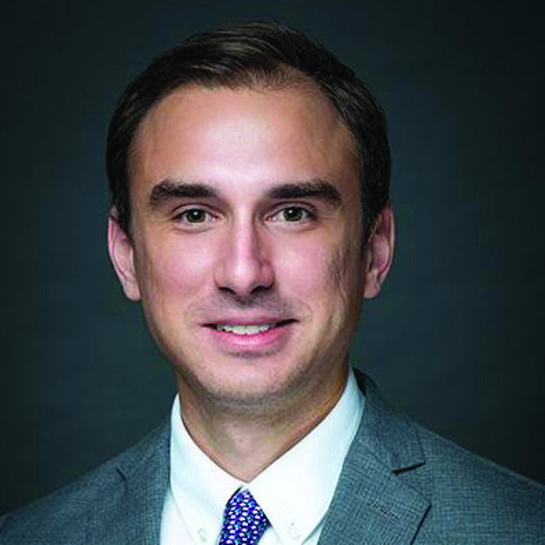
Rafael Ceja Ayala
Presidential Postdoctoral Fellow, Arizona State University
Rafael Ceja Ayala is a Presidential Postdoctoral Fellow in the School of Mathematical and Statistical Sciences at Arizona State University. His research interests include direct and inverse problems for partial differential equations, direct and inverse scattering, transmission eigenvalue problems, and qualitative reconstruction methods.

Stay Up-to-Date with Email Alerts
Sign up for our monthly newsletter and emails about other topics of your choosing.