
#MathSciOnTheHill Advocacy Event Unites Hundreds of Mathematicians in Washington, D.C.
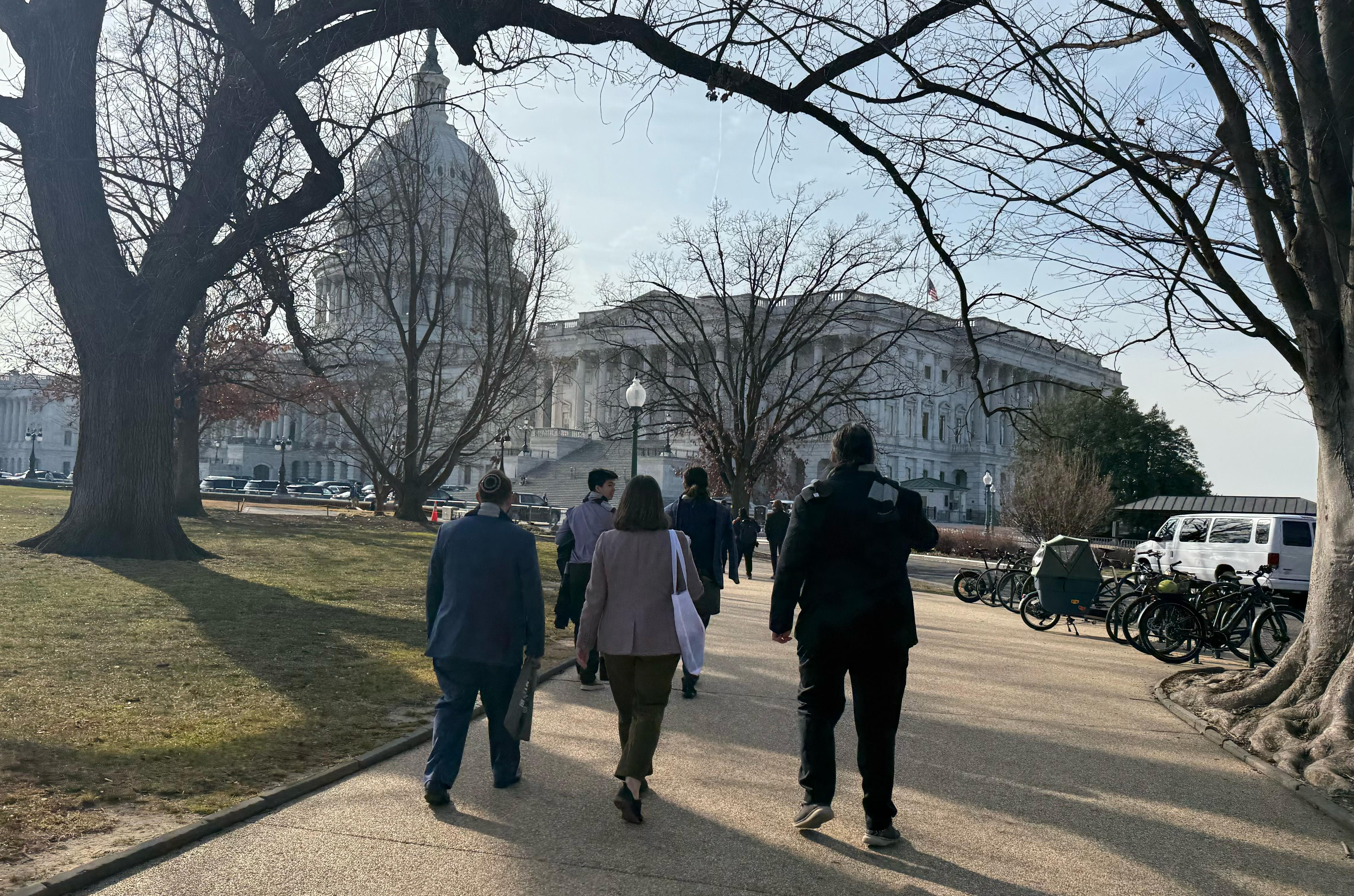
On January 8—after the conclusion of the Joint Mathematics Meetings, which took place in Washington, D.C.—nearly 300 mathematical scientists descended on Capitol Hill to advocate for and communicate the importance of mathematics, statistics, and related fields to U.S. senators, representatives, and their staff members. These mathematicians represented 12 different professional societies, including SIAM, and hailed from 47 states as part of a coordinated advocacy initiative called #MathSciOnTheHill, which sought to gain federal support for mathematics research and education. Attendees at all stages of their careers—from undergraduates to senior faculty members—came out on behalf of the event and sported distinctive scarves, which made it easy for participants to find each other while walking the grounds of Capitol Hill.
Here, we reflect on our individual experiences at #MathSciOnTheHill, which took place on the same day that the U.S. House of Representatives overwhelmingly passed a spending package that included near-stable funding for the U.S. National Science Foundation (NSF).
The Utah Delegation,
Emily Evans
Our Utah delegation consisted of three faculty members from Brigham Young University (BYU) and Westminster University, and three undergraduate students from BYU. As a member of the SIAM Committee on Science Policy and a former SIAM Science Policy Fellow from the inaugural 2018-2019 class [1], I am used to advocating for federal math and science funding on Capitol Hill. However, bringing undergraduates to Capitol Hill for the first time was a new and exciting experience. Their voices were particularly relevant as we talked in different offices — not only because they were closer in age to the congressional staffers, but because they were able to provide staff with direct insight as to why their age group is so interested in funding for mathematics and related fields.
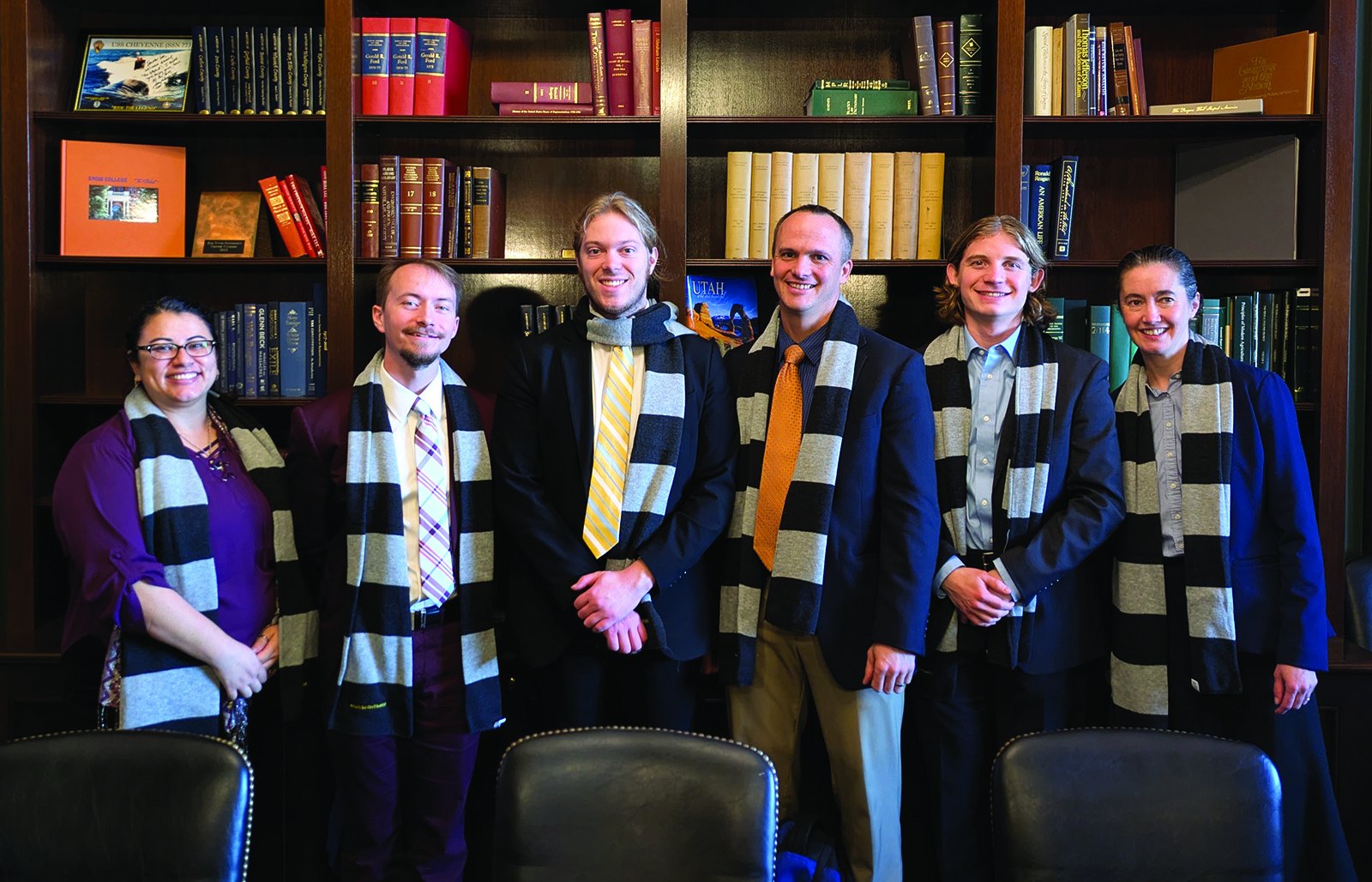
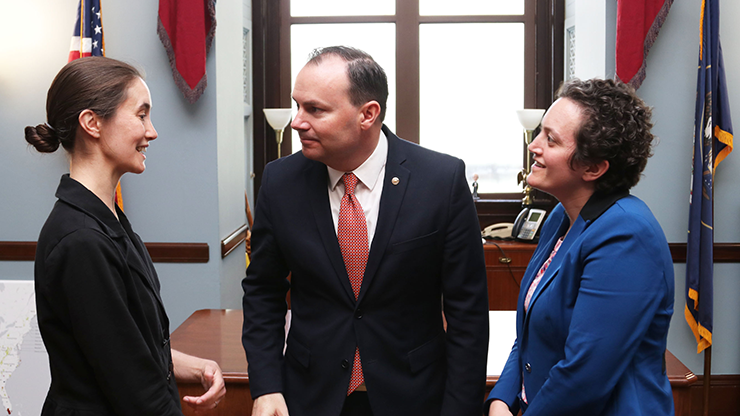
One of the highlights of our day was the opportunity to meet with Rep. Mike Kennedy (R-Utah), who graciously carved out time in his busy schedule to visit with us in his office. He actively listened to what we had to say, asked hard-hitting questions about the benefits of math and science funding in the state of Utah, and spoke to the undergraduate students about the direct impact of such funding within their demographic.
In addition to our visit with Congressman Kennedy, we also met with a staffer from Rep. Burgess Owens’ (R-Utah) office. This valuable conversation allowed us to share our thoughts with a wider audience and affirmed to the undergraduates that their opinions and viewpoints are indeed valued.
Since most senators and representatives from Utah serve on committees that address scientific funding, our primary message focused on the importance of funding for the NSF. We also talked about the growing influence of artificial intelligence (AI) and Utah’s role to help guide AI policy decisions. The message about AI was well received by all of the offices during #MathSciOntheHill, and especially by the staffers of our two Utah senators.
When reflecting on the day’s experiences, undergraduate Ethan Petersen spoke highly about the benefits of witnessing governmental action in person. “My favorite part was to simply be in the office buildings and feel the energy,” he said. “It was a remarkable thing to be in a place where decisions are made that impact many people. I was so happy to represent the math community and be involved to a new degree in government.”
The New Mexico Delegation,
Jonas Actor
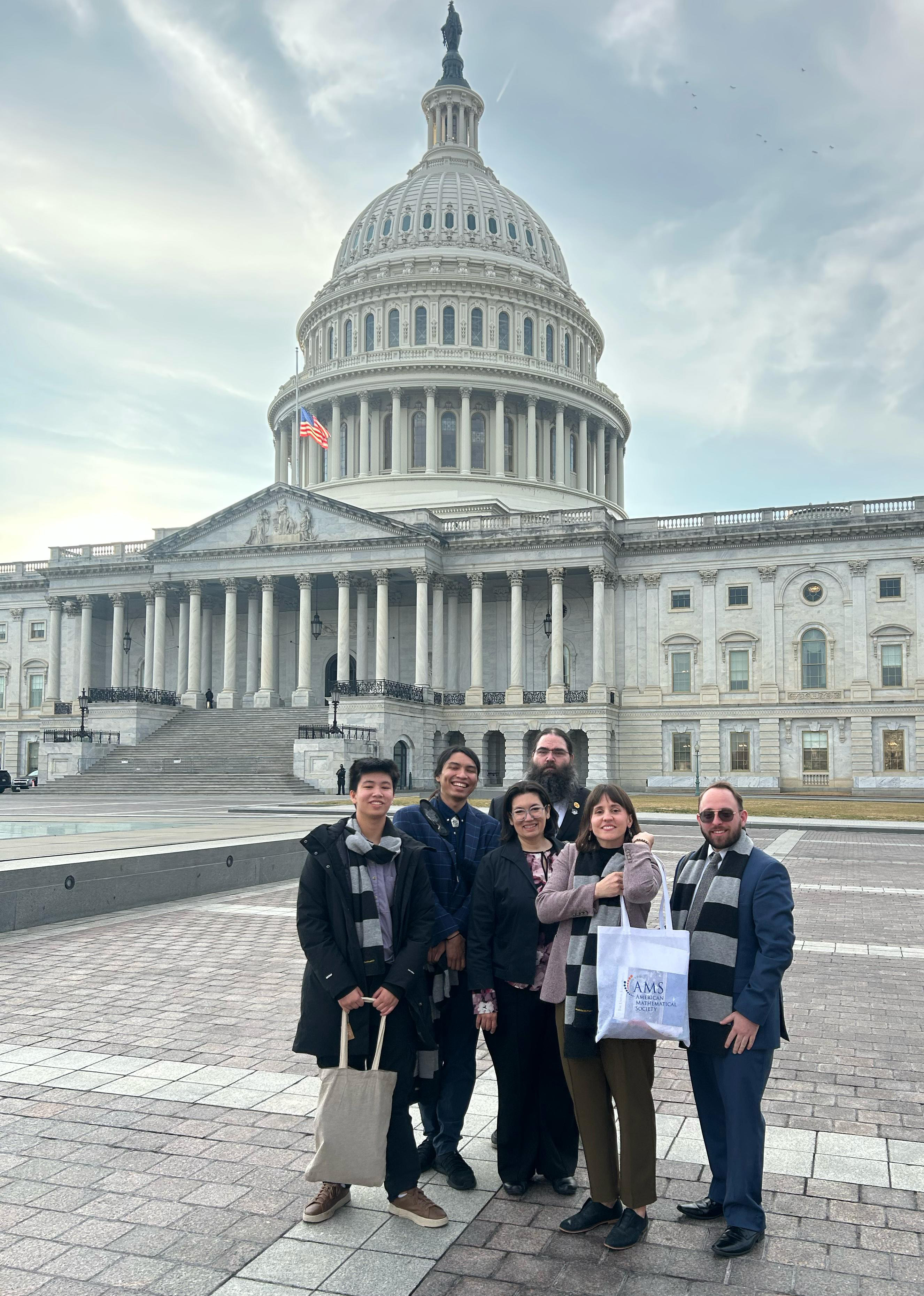
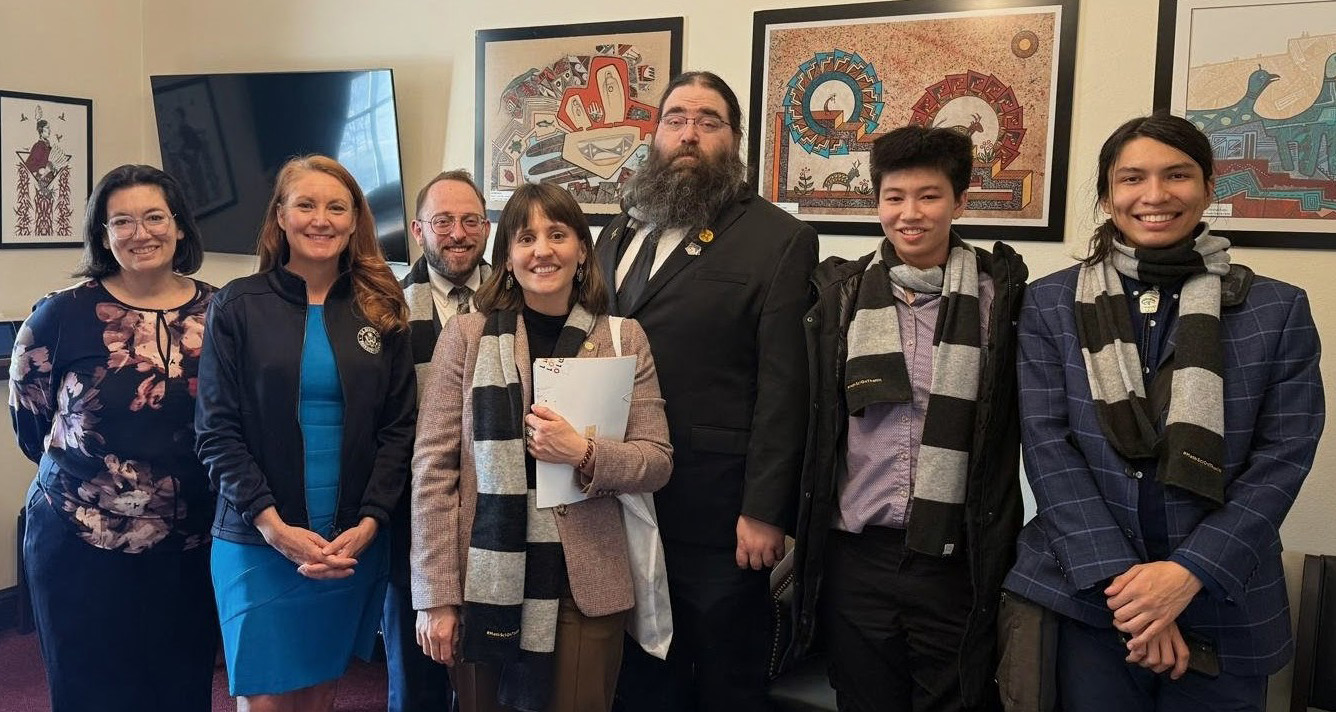
Our New Mexico delegation comprised a total of six mathematicians from a variety of professional backgrounds: a faculty member from the University of New Mexico, a staff member from Sandia National Laboratories, a postdoctoral researcher from the U.S. Air Force Research Laboratory, the executive director of a mathematics nonprofit residential summer camp in New Mexico called the CAMP for Algorithmic and Mathematical Play, and two undergraduate New Mexico constituents. After morning visits with staffers from the offices of New Mexico senators, we proceeded to the office of Rep. Melanie Stansbury (D-NM) to meet with members of her team. As with our previous appointments, we thanked them for their prior support of funding for basic research and the mathematical sciences, detailed the positive impacts of sustained investment in mathematical research on emerging technologies, and explained how math-based opportunities at all stages of the educational pipeline translate into benefits for both local economies and the state at large. Specific facts that staffers could relay to the Representative were particularly welcome (for example, “New Mexico has the most mathematics Ph.D.s per capita in the country!”).
As we were departing, the door opened and Rep. Stansbury entered her office. She immediately joined the conversation and listened as we described the purpose of #MathSciOnTheHill. After talking for nearly 15 minutes, she casually mentioned that she was headed to the House chamber floor to vote on the afternoon agenda and invited us to accompany her and observe from the House gallery. She escorted us through the members-only warren of passageways that connect the House office buildings to the basement of the Capitol, pointing out details as we went: artwork from high school students that line the walls; the terrifying bundle of cables and wires—three feet in diameter—that support the information technology systems for the Capitol offices and dangle from the basement ceiling; and the variations in types of tile within the Capitol, each reflecting the age of different additions to the building.
From the Capitol Rotunda, Rep. Stansbury proceeded to the chamber floor while a staffer escorted us to the House gallery. After divesting our possessions at the security desk, we continued upstairs to the gallery and watched the proceedings on the floor below. The staffer made sure to discretely point out notable figures on the floor—including Rep. Nancy Pelosi (D-Calif.), Rep. Alexandria Ocasio-Cortez (D-NY), and Speaker Mike Johnson (R-La.)—as the representatives mingled between votes.
As it turns out, the House was actively in session and voting on various pieces of legislation. When we entered, voting had just commenced for a round of appropriations to fund minibus packages — including the budgets for federal science and energy funding for agencies such as the NSF and U.S. Department of Energy (DOE). These agencies have broadly supported my past and current research and fund many of the main federal mathematical and computational science research programs.
Watching Congress approve these budgets was a high point of my two years as a SIAM Science Policy Fellow. Throughout the course of the Fellowship, I have engaged with the SIAM Committee on Science Policy to debate merits, priorities, and strategies for how the applied mathematics community can best inform federal policy and stakeholders—such as the NSF’s Division of Mathematical Sciences and the DOE Office of Science’s Advanced Scientific Computing Research program—about the necessity, importance, and impact of applied mathematics and computational science research. It was therefore fitting that at the end of my two-year term as a Science Policy Fellow, I had the incredible privilege of observing the federal funding process in its entirety. #MathSciOnTheHill provided a concrete demonstration of the power of SIAM’s science policy work and its ability to influence the direction of mathematics research across the country.
What You Can Do
Although we have been actively involved with the SIAM Committee on Science Policy over the years, you do not have to be a committee member to serve as a champion of mathematics and science. It was certainly exciting—and frankly a lot of fun—to bring such a large contingent of mathematicians to Capitol Hill. However, plenty of advocacy work for scientific funding is possible from the comfort of your own home or office. The most powerful thing that SIAM members can do is educate their peers about the way in which math and science funding directly benefits them. Whether you are explaining how AI is driven by mathematics or talking about how math and science research improve medicine, every individual with whom you speak has the potential to become an advocate. For more information about SIAM’s ongoing efforts in the realm of U.S. science policy, please visit the Society’s “Science Policy” webpage.
Additionally, if you are feeling bolder, you may wish to email and/or call your senators and representatives, especially in this challenging political environment. Doing so sends a message that their constituents care about funding in math and science. If you are not sure what to say, we encourage you to take a look at SIAM’s guidelines for engaging with congressional offices, as well as a series of one-pagers that are available online. And as always, please feel free to share your outreach stories with SIAM to help inform future initiatives, activities, and advocacy efforts.
References
[1] Evans, E. (2020, September 1). It’s all about the story: Reflections of a former Science Policy Fellowship recipient. SIAM News, 53(7), p. 8.
About the Authors
Jonas A. Actor
Senior Member of Technical Staff, Sandia National Laboratories
Jonas A. Actor is a Senior Member of Technical Staff in the Center for Computing Research at
Sandia National Laboratories. He served as a 2024-2025 SIAM Science Policy Fellow.
Emily Evans
Associate professor, Brigham Young University
Emily Evans is an associate professor and chair in the Department of Mathematics at Brigham Young University. She is a member of the SIAM Committee on Science Policy, prior to which she served as a 2018-2019 SIAM Science Policy Fellow.
Related Reading
Stay Up-to-Date with Email Alerts
Sign up for our monthly newsletter and emails about other topics of your choosing.