
Overlooked History Revealed
The Secret Lives of Numbers: A Hidden History of Math’s Unsung Trailblazers. By Kate Kitagawa and Timothy Revell. HarperCollins Publishers, New York, NY, July 2024. 320 pages, $32.99.
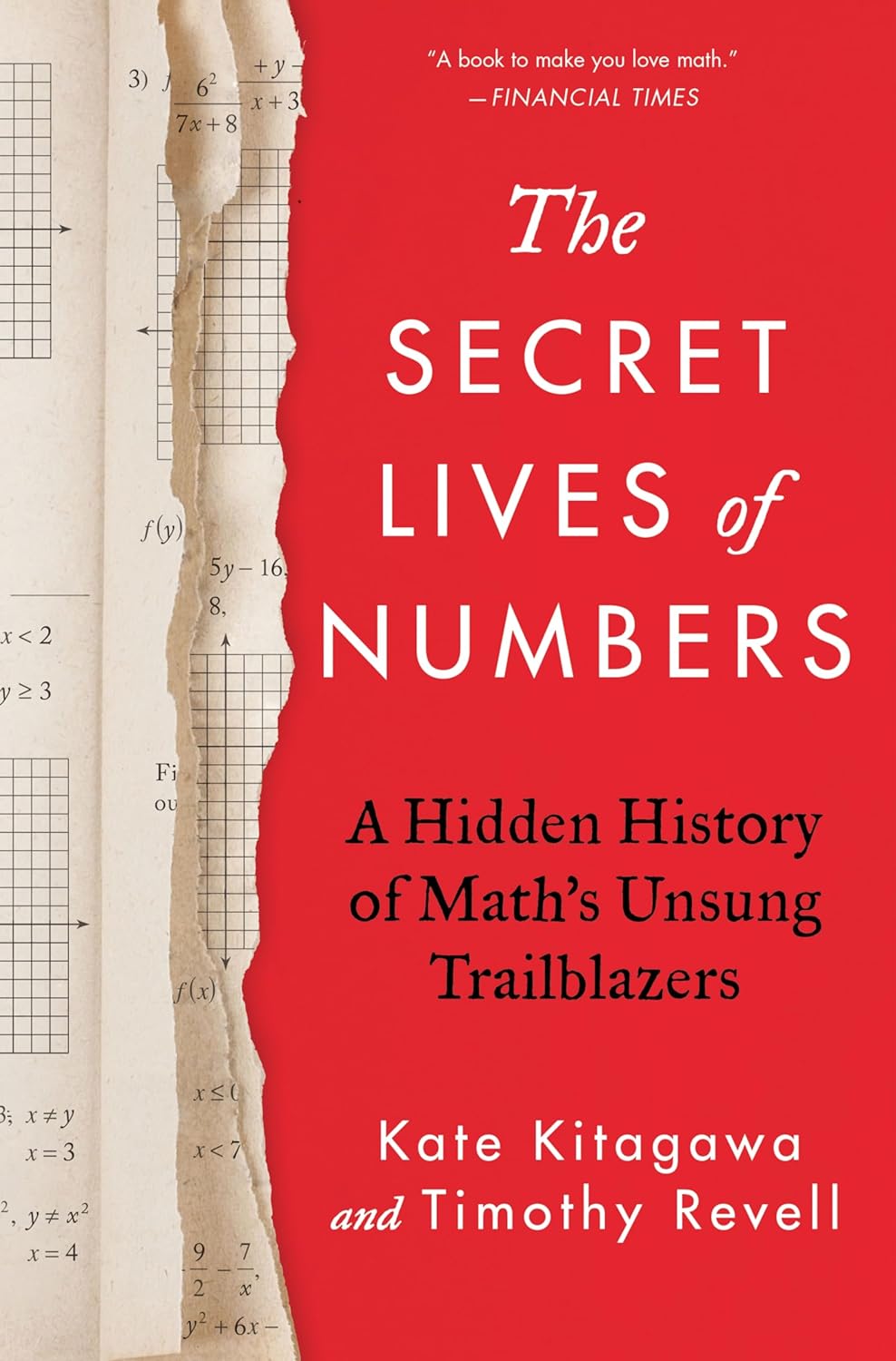
Mathematicians know that projecting the surface of a sphere onto a plane is an error-prone undertaking. If that sphere is a map of the Earth, then the two-dimensional version can severely distort the relative sizes and proximities of nations and territories — warping the corresponding cultural perspectives that these geographic relationships suggest. In The Secret Lives of Numbers: A Hidden History of Math’s Unsung Trailblazers, authors Kate Kitagawa and Timothy Revell offer a well-crafted historical survey that seeks to rectify geographic imbalances in perceptions of mathematical development while engaging readers in the evolution of mathematics as an iconic human achievement.
For mathematicians, the overall reading experience is akin to visiting a museum to view a retrospective of a beloved artist. Two skilled docents guide readers through little-known early works that presage the genius of well-known masterpieces or hint at revolutionary visions of familiar objects. My applied mathematician’s eye could not help but notice that most early mathematical endeavors served the community needs of their time and culture in several ways, such as accurately recording and marking the extent of territory or guiding the planting of crops into propitious seasons. Abstraction and notions of proof emerged later as mathematical self-perception matured.
The painful stone in readers’ shoes throughout this retrospective tour is the persistent gender, ethnic, and class biases in these preliminary mathematical establishments, which apparently reflected the cultural norms of the societies in which they were embedded. The most notorious example might be the treatment of Russian mathematician Sofia Kovalevskaya [1], whose career and reputation were plagued by demeaning gossip and sexual stereotypes — despite the prestige of her winning the French Academy of Science’s Prix Bordin in 1888. Similarly, mathematics faculty at historically Black colleges and universities in the U.S., such as Howard University, have had to stand as breakwaters against relentless tides of racism that sought to exclude talented mathematicians of color from entering the profession.
The scope of The Secret Lives of Numbers is wide, beginning 4,000 years ago with the legend of the Chinese emperor Yu the Great, who established the first Chinese imperial dynasty. While wading in the Yellow River, he is said to have received the alleged “Mandate of Heaven” by discovering a magic square1—a symbol of mathematical perfection—that was inscribed with Chinese numerals among the irregular markings on the back of a turtle. This auspicious pattern granted Yu the authority to present himself as rightful leader of the kingdom. As the authors note, “Mathematics in ancient China was power.”
Some of the mathematical rituals that we take for granted in the present day seem to have manifested themselves in the ancient world. Whenever mathematicians in early societies would gather at local centers of excellence (to use modern vocabulary), scribes would laboriously record all that was known about important topics of the day. Plant leaves or clay tablets usually sufficed for what were essentially very early precursors to SIAM Review articles or lecture notes, like those published by the Conference Board of the Mathematical Sciences. One such ancient “review article,” inscribed on a clay tablet, reveals that mathematicians in the city of Babylon (about 100 kilometers south of modern-day Baghdad) were aware of the calculations behind the Pythagorean theorem long before Pythagoras and his colleagues were active in Greece. Another Babylonian tablet correctly approximated the square root of 2 to six decimal digits.
The Secret Lives of Numbers presents other accounts that trace the scientific similarities of ancient and modern society. In the eighth century CE, the Abbasid Caliphate—aided by prisoners from the Chinese army and their extensive knowledge of paper making—constructed the first-ever paper mill in Samarkand (now in Uzbekistan), which inspired an explosive accumulation and diffusion of knowledge that altered the trajectory of mathematics’ intellectual development. Throughout the centuries, mathematical discovery continued apace across the globe in China, southern Asia, and the Maya civilization in Mesoamerica. Eventually, the book’s storyline turns to Europe, Greece, and the U.K. Some of the more familiar accounts include charming vignettes of the interactions among G.H. Hardy, J.E. Littlewood, Srinivasa Ramanujan, and Mary Cartwright, including Cartwright’s rise to the presidency of the London Mathematical Society.
Kitagawa and Revell’s epilogue—which was no doubt written as the skies over American science were darkening but before the first thunderbolts struck—is relentlessly optimistic, extrapolating from the field’s vibrant history to predict a sunny future for our discipline. U.S. mathematicians can only hope that history will repeat itself.
1 A three-by-three grid of integers whose rows, columns, and diagonal sums are equal — the framework for the ubiquitous Sudoku puzzles.
References
[1] Davis, E. (2022, April 1). Sofia Kovalevskaya: Mathematician and writer. SIAM News, 55(3), p. 7.
About the Author
Paul Davis
Professor emeritus, Worcester Polytechnic Institute
Paul Davis is a professor emeritus of mathematical sciences at Worcester Polytechnic Institute.


Stay Up-to-Date with Email Alerts
Sign up for our monthly newsletter and emails about other topics of your choosing.