
Reflections on the SIAM EDI Change Agents Program
Over the 2024-2025 academic year, the SIAM Equity, Diversity, and Inclusion (EDI) Change Agents Program provided a platform for SIAM members to pursue specific EDI initiatives in their workplace, teaching, and research communities and leverage their capacities as researchers and educators to improve EDI within the applied and computational mathematics space.
In 2024, as a special initiative of Ron Buckmire—SIAM’s Vice President for Equity, Diversity, and Inclusion at the time—the Office of the Chief Executive Officer awarded modest grants of up to $2,500 to four individuals or small teams who successfully outlined intended projects that support EDI at their institutions and/or within the broader community. The EDI Change Agents were as follows:
- Alejandra Castillo of Pomona College and Christina J. Edholm of Scripps College
- Anastasiia Minenkova of the University of Hartford
- Elizabeth Newman of Tufts University and Elizabeth Qian of the Georgia Institute of Technology
- Ruth Alejandra Torres-Rubiano of Fundación Universitaria Konrad Lorenz in Colombia.
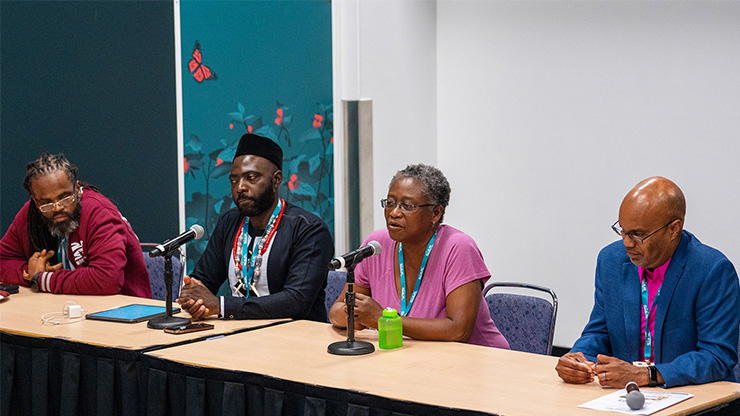
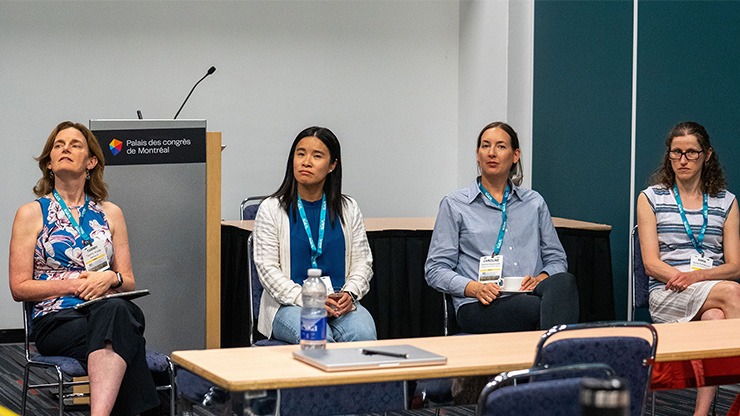
All Change Agents completed their projects over the course of a year and presented their results during an in-person and virtual minisymposium session at The Third Joint SIAM/CAIMS Annual Meetings (AN25), which took place this past summer in Montréal, Québec, Canada.
Here, these individuals reflect on their experiences; explain their projects; and speak about the importance of EDI enterprises in science, technology, engineering, and mathematics (STEM). More information about the EDI Change Agents is available online.
Alejandra Castillo
Pomona College
Through the SIAM EDI Change Agents Program, Christina Edholm of Scripps College and I set out to explore the role of mathematics as a bridge between students, data, and the community. Our project, “Modeling the Opioid Epidemic in the Inland Empire,” grew from a partnership with the Inland Empire Opioid Crisis Coalition: a regional organization in California that responds to opioid dependence and misuse. Together, we developed a summer research experience for undergraduates that combined mathematical modeling, statistical analysis, and public health data. Students investigated overdose patterns in California’s San Bernardino and Riverside counties while reflecting on the ethical dimensions of applied research and the data’s social context.
This project served as the first hands-on research endeavor for all students. “It helped me solidify topics I learned in probability and biostatistics and see their applications,” one student said. “It also shaped my perspective on math and my place in mathematical spaces.” Another participant agreed that the experience honed their technical prowess. “Although confusing at first, it ultimately helped us enter the world of applied statistical modeling,” they said. “Working on a small team pushed a holistic form of communication that drove the project out of its muddy moments.”
A third student reflected on the project’s direct connection to the real world. “It allowed me to understand more about the community around me and how our statistical approach provides insights that a qualitative study cannot illustrate,” they said. “It showed me that statistics can do real good and even inspired me to consider public health research as a career.”
Christina and I presented our work during the virtual component of AN25 , where we connected with like-minded individuals who are pursuing similar goals that pertain to inclusion and systemic change. We enjoyed learning about the scopes, timelines, and approaches of other people’s projects; their explanations of challenges and partnerships offered valuable perspectives and reaffirmed the importance of mentorship in this kind of undertaking.
The SIAM EDI Change Agents Program made these student experiences possible. Support from SIAM enabled us to connect mathematical learning with meaningful social impact, allowing students to visualize themselves as researchers for the first time. The grant supported both their research and their growth as learners, collaborators, and contributors to the broader mathematical community.
Anastasiia Minenkova
University of Hartford

As a faculty member in the Department of Mathematics at the University of Hartford, I used my position as a SIAM EDI Change Agent to lead an initiative that created a more welcoming and supportive environment for mathematics students from all backgrounds. This initiative was rooted in a broader vision to popularize mathematics, reduce bias in professional decision-making situations, address historical disparities in the field, and introduce ethical and inclusive practices to a wide audience. I wanted to ensure that students saw themselves reflected in the discipline and felt empowered to pursue mathematics with confidence and purpose.
One of the central components of my project was the creation of the Mathematics EDI Community Library: a curated collection of approximately 20 titles in our department’s lounge. These books explore themes of equity, inclusion, ethics, and the social dimensions of mathematics. By making these resources easily accessible, I hoped to spark conversations and reflection among students, faculty, and visitors.
To further engage our community, I organized a series of film screenings that highlighted stories of resilience, empowerment, and justice in STEM. We watched Coded Bias, Journeys of Black Mathematicians: Forging Resilience—which was shown at the 2024 SIAM Annual Meeting—and The Empowerment Project: Ordinary Women Doing Extraordinary Things. These films served as powerful segues for discussion and helped students connect mathematics to broader societal issues.
We also hosted social events to build community among mathematics majors. During these gatherings, students wrote pi-kus—a unique spin on the Japanese haiku, inspired by the digits of \(\pi\)—shared pie, and reflected on the films’ various themes. These more informal moments of connection, which helped attendees feel seen and supported by their peers, were just as impactful as the formal programming.
Other highlights of the initiative included visits and testimonies from a diverse group of guest speakers who spoke about their academic journeys and research endeavors. The speakers actively engaged with students during their presentations, sparking meaningful dialogue and offering a level of mentorship that expanded students’ perspectives of possible careers in mathematics.


One of the most exciting outcomes of this project was that it emboldened students to create a petition to initiate a SIAM student chapter at the University of Hartford. Inspired by the community-building and leadership opportunities in which they partook, students worked to establish a chapter that will continue to promote mathematical engagement, professional development, and inclusive practices on campus.
My SIAM EDI Change Agents project was deeply personal to me. I believe that mathematics should be a space where everyone feels a sense of belonging, curiosity is nurtured, diverse voices are valued, and students are empowered to lead. Thanks to support from SIAM, I was able to take concrete steps toward that vision.
The Mathematics EDI Community Library remains open within Hartford’s Department of Mathematics, and the conversations it inspires continue to grow. I am proud of what we have built and excited to see how this work will continue to evolve in the coming years.
Elizabeth Newman
Tufts University
As computational mathematicians, we have the opportunity to pursue exciting, multifaceted, and collaborative research to ultimately develop rigorous mathematical theory and reliable, practical algorithms for real-world applications. However, getting started in the computational mathematics research space requires a robust mathematical background and strong programming skills. The high barrier to entry has driven motivated, talented students into alternative fields with more accessible opportunities for research in the early stages of their academic careers. As SIAM EDI Change Agents, Elizabeth Qian of the Georgia Institute of Technology (GT) and I sought to lower the barrier to entry in computational mathematics and begin to systematically address the inequities in access within this field of research.
To this end, we established a cross-institutional undergraduate research program at GT and Emory University (where I was an assistant professor at the time) that emphasized exploratory, hands-on computational projects and community building. Our cohort of four amazing first-year students was split into two teams, each of which included one GT and one Emory representative. Through collaborative projects that focused on machine learning and uncertainty quantification, our students gained newfound insight into the scope of computational mathematics.


Feedback from our participants was overwhelmingly positive. “As a first-year, I had no prior experience with research,” one student wrote. “The program gave me an idea of just how important basic mathematical concepts are…not only to engineering, but to the founding principles of computing. The best part of the program, though, was definitely working with a partner. Going through a first-time research experience with someone by my side allowed us to ask more questions [and] enriched our learning even more.”
Elizabeth and I co-mentored the two teams via weekly office hours that alternated between institutions. We fostered an open and supportive community by hosting dinners, setting expectations for regular in-person meetings amongst teams, and encouraging our cohort to plan a fun excursion (they chose to visit a famous haunted house). To conclude the program, students presented scientific posters at the Georgia Scientific Computing Symposium, a local one-day workshop that took place at GT in February 2025. Their professors, friends, and family members came to support their excellent work.
Mentoring these endlessly enthusiastic first years and watching them learn new mathematical concepts, utilize computational skills and real data to put math into practice, and support each other throughout the process filled us with pride and reenergized us every week. We came away from the SIAM EDI Change Agents experience with a new appreciation for the value of a strong peer and mentor support network in the pursuit of learning and research. As such, we are grateful to be a part of the SIAM community and its mission to advance applied and computational mathematics through research and collaboration.
Ruth Alejandra Torres-Rubiano
Fundación Universitaria Konrad Lorenz

My participation in the SIAM EDI Change Agents Program had a tangible impact on the promotion of EDI in mathematics in Bogotá, Colombia — on a scale that I hadn’t imagined was fully possible. It gave me the opportunity to breathe life into a project that I had been envisioning for more than a year, and it created a wonderful network of students and professors that were united by a shared goal: strengthening the presence of women in STEM fields.
I designed and led a project called Mujer-K-es-STEM at Fundación Universitaria Konrad Lorenz that serves as an interdisciplinary space for learning and mentorship for young women who are interested in science and technology. In addition to exploring various areas of STEM, the program included important components on life skills such as mental health, healthy habits, coping with change, decision making, self-awareness, career orientation, and university scholarships. This multifaceted approach established Mujer-K-es-STEM as a truly comprehensive learning experience — one that not only inspired scientific curiosity but promoted personal confidence and well-being among participants.
The team behind this first edition comprised 14 women professors from diverse disciplines—mathematics, physics, engineering, psychology, marketing, sociology, and the arts—along with female students and graduates from our mathematics and engineering department. This array of perspectives and experiences ensured that participants were constantly surrounded by female role models.
In total, 24 young women in grades nine to 11 from various public and private schools in Bogotá—most of them from low-income backgrounds—successfully completed the program and received certification. Their feedback was overwhelmingly positive and highlighted the closeness of the mentors, usefulness of the workshops, and newfound inspiration from the shared experiences throughout the sessions.

The SIAM EDI Change Agents grant was essential in making Mujer-K-es-STEM a reality and allowed us to launch the first version of the project with substantial reach and quality. We were able to provide meals and materials for participants, including notebooks, sweatshirts, and commemorative pins that helped to build a strong sense of belonging and community. In addition to its practicality, this funding sent a powerful message to the students by demonstrating that international mathematical organizations like SIAM value inclusion, collaboration, and female participation in STEM. The recognition also introduced them to these types of organizations and their widespread global impact. Following the success of the 2025 edition of Mujer-K-es-STEM, we are now seeking new funding sources to offer the program on an annual basis.
Presenting this work in person at AN25 was also a very meaningful experience. I received valuable feedback, piqued audience members’ interest in this kind of initiative, met inspiring people from the SIAM Activity Group on EDI, and connected with another SIAM EDI Change Agent during our minisymposium session. These exchanges helped me create new professional networks and return to Colombia with fresh ideas and renewed motivation to continue the development of spaces that connect scientific training with inclusion and personal growth.
About the Authors
Alejandra Castillo
Instructor of mathematics and statistics, Pomona College
Alejandra Castillo teaches mathematics and statistics at Pomona College, where she uses data and statistical methods to study problems in biology and public health. She is also interested in introducing students to statistical computing and data science and broadening participation in the mathematical sciences.

Anastasiia Minenkova
Assistant professor, University of Hartford
Anastasiia Minenkova is an assistant professor at the University of Hartford who works in numerical linear algebra and its applications to quantum computing. She is dedicated to mentoring undergraduate students and advancing inclusion in mathematics.

Elizabeth Newman
Assistant professor, Tufts University
Elizabeth Newman is an assistant professor in the Department of Mathematics at Tufts University and a 2025-2026 Merrin Faculty Fellow. She earned her Ph.D. from Tufts in 2019. Newman received an Air Force Fiscal Year 2025 Young Investigator Program Award and is a joint recipient of the 2025 SIAM Activity Group on Computational Science and Engineering Best Paper Prize.

Ruth Alejandra Torres-Rubiano
Director of the Mathematics Program, Fundación Universitaria Konrad Lorenz
Ruth Alejandra Torres-Rubiano is a Colombian mathematician and alumna of the Universidad Nacional de Colombia, where she also earned a master’s degree in philosophy. She serves as dean of the Faculty of Mathematics and Engineering and director of the Mathematics Program at Fundación Universitaria Konrad Lorenz. She also presides over the Gender Equity Commission of the Colombian Mathematical Society.


Stay Up-to-Date with Email Alerts
Sign up for our monthly newsletter and emails about other topics of your choosing.