
SIAM Texas-Louisiana Section Holds 8th Annual Meeting
The Texas-Louisiana Section of SIAM held its 8th Annual Meeting (TXLA 2025) on a beautiful fall weekend in late September at the University of Texas at Austin’s Oden Institute for Computational Engineering and Sciences. Conference attendance has been steadily growing over the years, and the 2025 meeting attracted more than 350 participants — most of whom were students (both graduate and undergraduate) and early-career researchers. Such a strong junior presence is by design, in that the event is very affordable and provides students with an excellent opportunity to present their research to an audience that includes internationally renowned experts in the field of applied mathematics. Additionally, the Texas-Louisiana Section annually awards 20 travel grants to encourage participation from students who are affiliated with local universities. This time, we were particularly happy to also welcome attendees from all over the country, which attests to the conference’s high scientific quality and growing stature.
The annual meeting routinely follows a well-tested formula that includes four plenary speakers, a career panel, a poster session, and five minisymposium blocks (with up to 17 parallel sessions in 2025), all between Friday and Sunday afternoon. Four esteemed leaders in the field of applied and computational mathematics delivered plenary talks on the following broad-interest subjects:
- Jean-Luc Guermond (Texas A&M University): “An Overview of Structure- preserving Approximation of Nonlinear Conservation Equations”
- Robert Lipton (Louisiana State University): “Damage and Fracture in Quasi-brittle Materials”
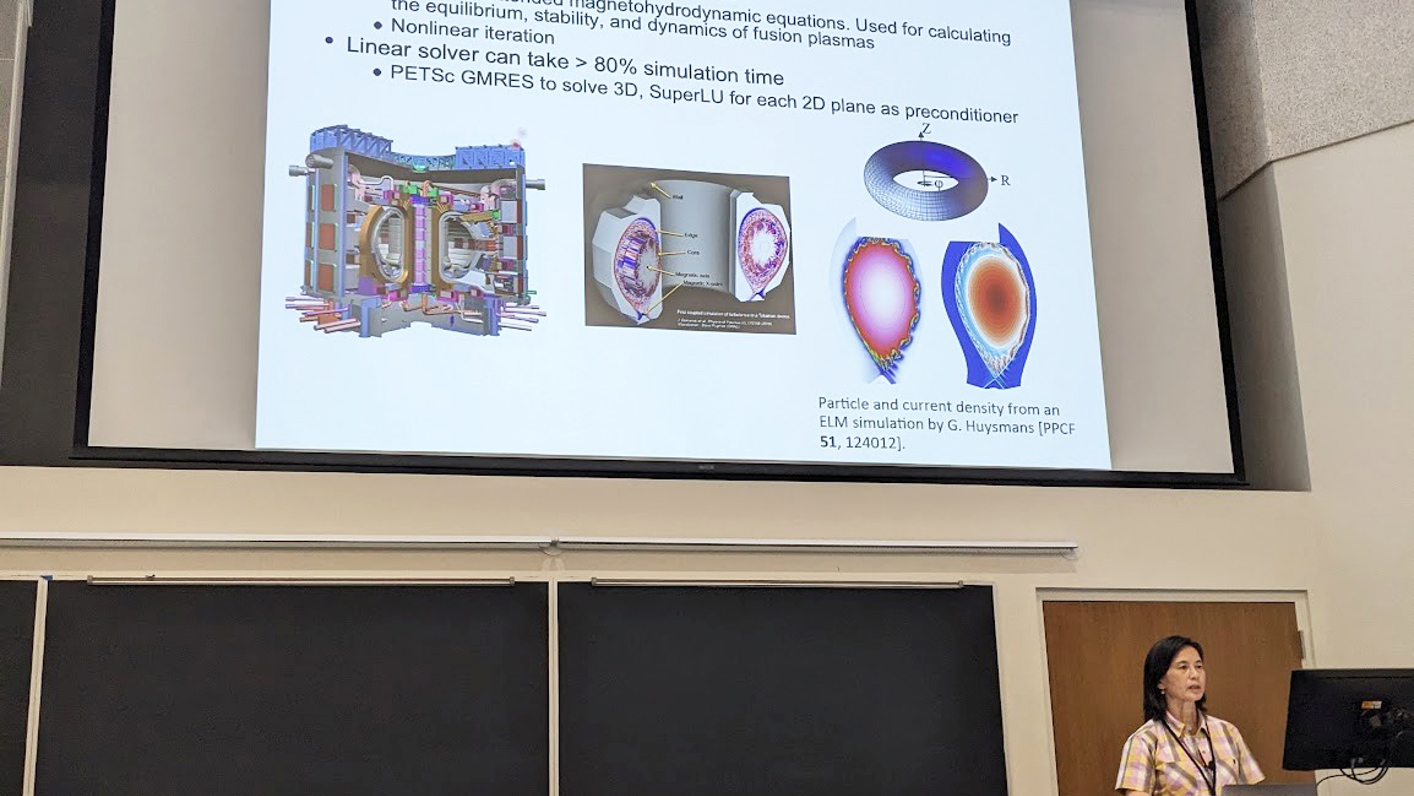
- Xiaoye Sherry Li (Lawrence Berkeley National Laboratory): “Building a Gaussian Process Statistical and Quantitative Learning Framework for Scientific Applications”
- Robert Ghrist (University of Pennsylvania): “Local-to-global: Network Sheaves and Cohomological Inference.”
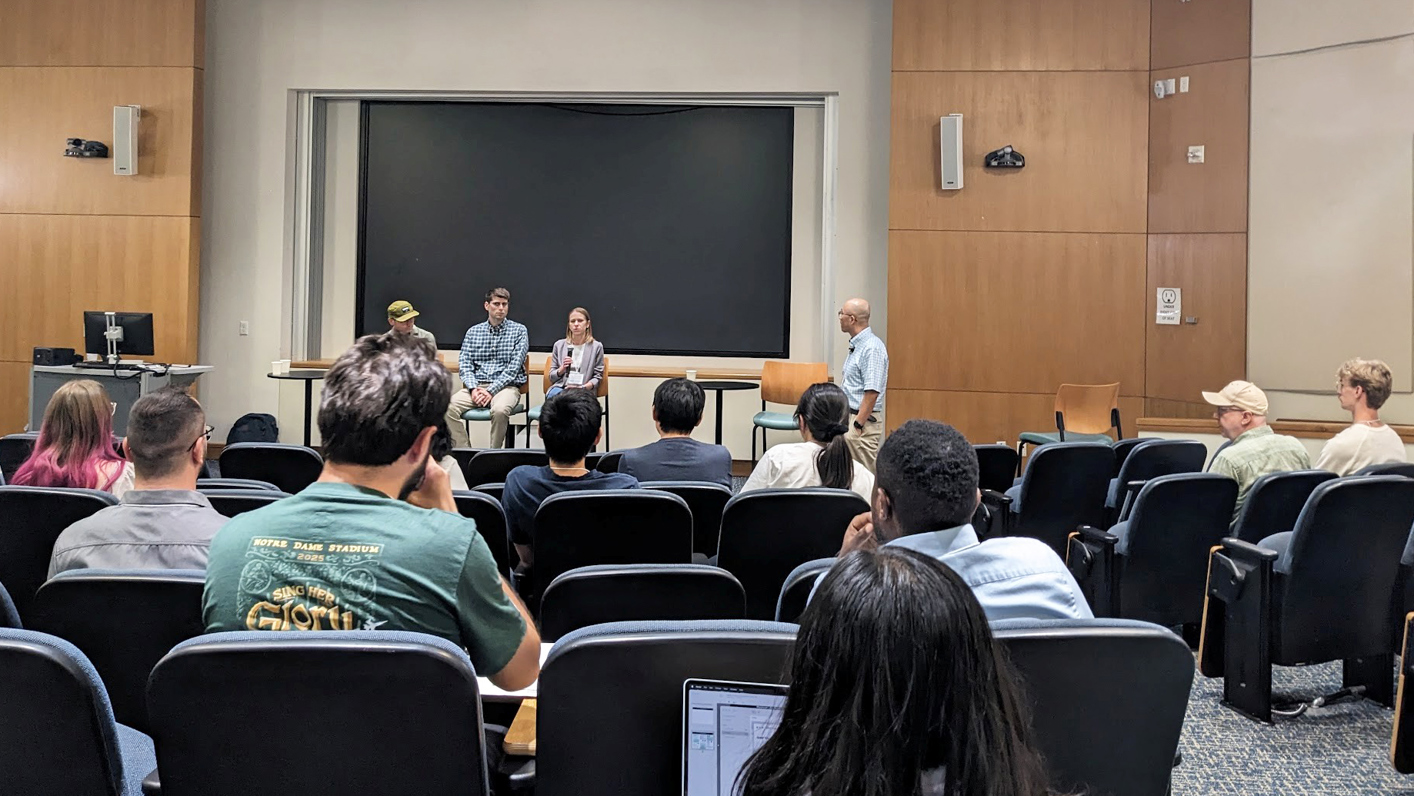
During the career panel, participants David Fridovich-Keil (University of Texas at Austin), Jon Loftin (MathWorks), and Svetlana Tokareva (Los Alamos National Laboratory) spoke about their career trajectories and fielded thoughtful questions from the audience. Moderator Weihua Geng (Southern Methodist University) kept the discussion going throughout the hourlong session.

After a full day of talks on Saturday, a lively poster session inspired a bit of friendly competition. To encourage poster presentations from attendees, we held a best poster contest whose winners received generous gift cards to purchase SIAM books. By popular vote, the 2025 winners and poster titles were as follows:
- Boluwatife Awoyemi (Texas Tech University): “Mapping Coexistence and Exclusion in Hybrid Timescale Systems: A Numerical Approach”
- Asikul Islam (University of Houston): “Efficient Numerical Methods for Multispecies Tumor Growth Simulations”
- Bobby Shi (University of Texas at Austin): “Efficient Tensor Decomposition Via Moment Matrix Extension”
- Damon Spencer (Rice University): “A New Approach for Solving the Mixed Integer PDE Constrained Source Inversion Problem.”
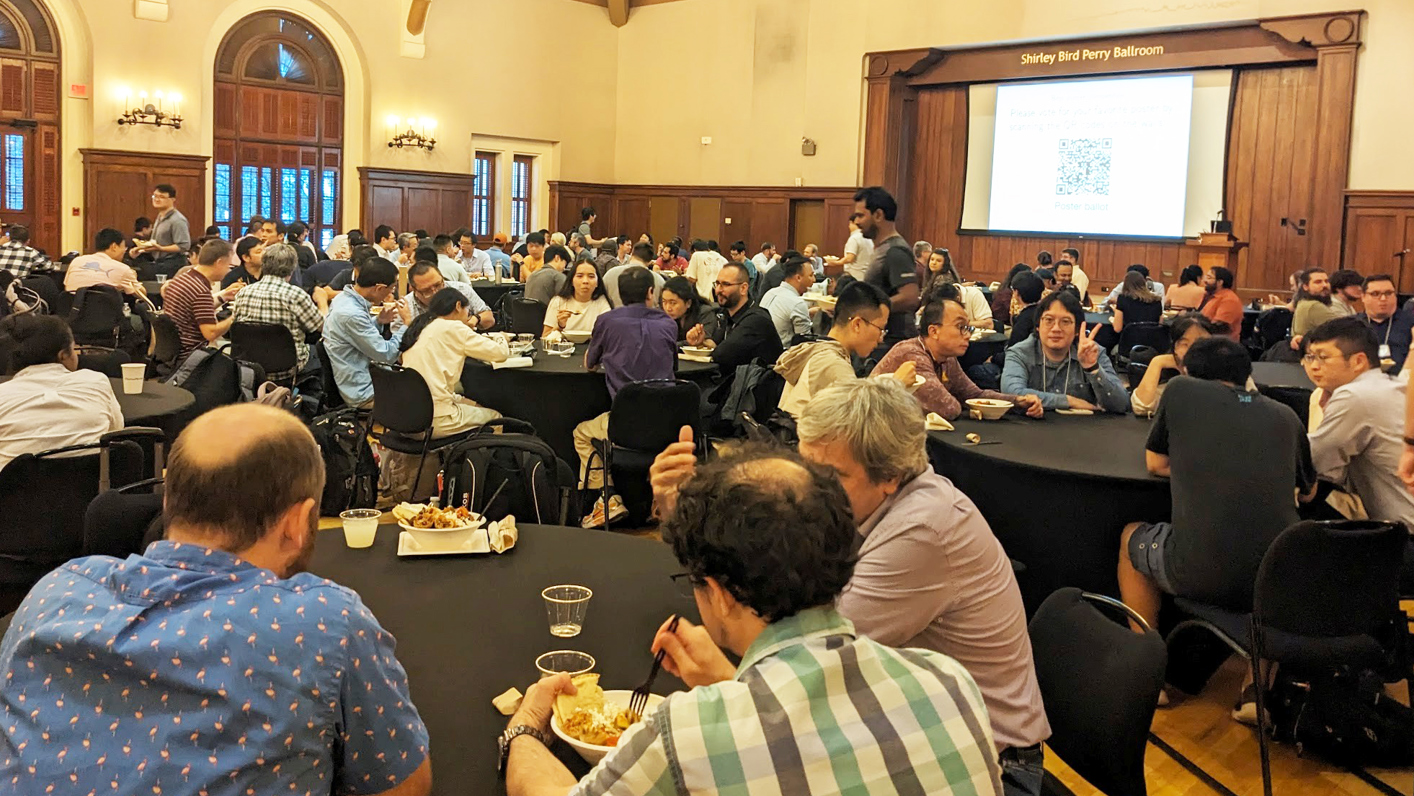
Following the poster session, everyone had the chance to get better acquainted, network, and mingle at the conference banquet, which took place in the Texas Union’s beautiful Shirley Bird Perry Ballroom.
In light of its success, it is worth noting that even a fruitful conference like TXLA 2025 does not come without difficulties. Historically, the meeting takes place from Friday afternoon to Sunday morning. We do not want to increase the duration of the event and complicate people’s schedules, but the growing number of participants poses an organizational and logistical challenge. Moreover, it is becoming harder to avoid overlap between minisymposia with similar topics that are of interest to the same crowd.
In the future, we might experiment with some new ideas for annual meetings. For example, a closing plenary lecture would give participants an incentive to stay until the end of the conference and provide an opportunity for concluding remarks. A networking session for junior researchers might also be a beneficial way to encourage them to socialize and hopefully initiate personal and professional relationships that will last throughout their careers. With the same goal of facilitating the expansion of personal and professional networks, we are likewise considering a longer poster session for future events.
As section chair and vice chair, we cannot conclude without acknowledging the hard work of the TXLA 2025 local organizing committee at the University of Texas at Austin, including Tan Bui-Thanh, Jesse Chan, Krishnanunni C G, Gabrielle Costello, Karen Rumpf, and Maria Stanzione; section treasurer Amy Veprauskas (University of Louisiana at Lafayette); section secretary Matthias Maier (Texas A&M University); and the rest of the organizing committee. The success of TXLA 2025 is due in large part to their diligence. We hope to see everyone again next year!
About the Authors
Annalisa Quaini
Professor, University of Houston
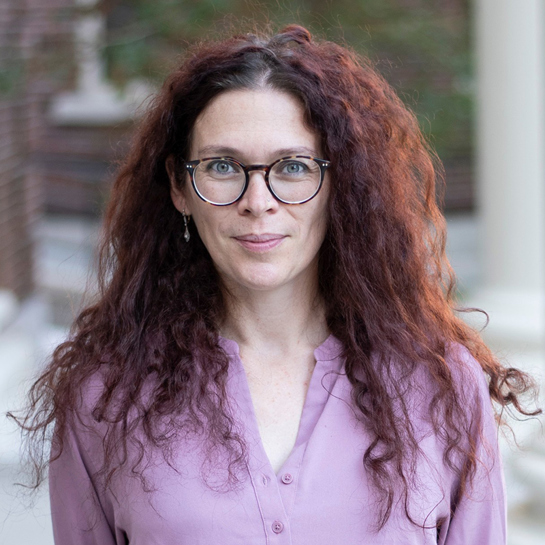
Annalisa Quaini is a professor of mathematics at the University of Houston. Her research interests include computational fluid dynamics and fluid-structure interaction with applications in medicine, biomedical engineering, and atmospheric science.
William Ott
Professor, University of Houston
William Ott is a professor of mathematics at the University of Houston who works in ergodic theory and dynamical systems. He utilizes ideas from dynamical systems to solve problems in a variety of areas, including applied topology, biochemical reaction networks, glucose-insulin dynamics, and scientific machine learning.
Related Reading
Stay Up-to-Date with Email Alerts
Sign up for our monthly newsletter and emails about other topics of your choosing.