
Strengthening SIAM’s Northern and Central California Research and Development Community at NCC25
The Northern and Central California (NCC) Section of SIAM serves as a regional catalyst for researchers whose work blends applied mathematics, computation, and the physical sciences. Founded in 2024, the section strives to provide students, early-career scientists, and other West-Coast-based SIAM members—some of whom may not be able to attend major SIAM conferences—with an opportunity to connect and experience the many offerings of local academic, national laboratory, and private sector communities. Following the highly successful inaugural NCC conference at the University of California (UC) Merced in 2024 [1], the 2nd SIAM Northern and Central California Sectional Conference (NCC25) took place at Lawrence Berkeley National Laboratory (LBNL) in October 2025.
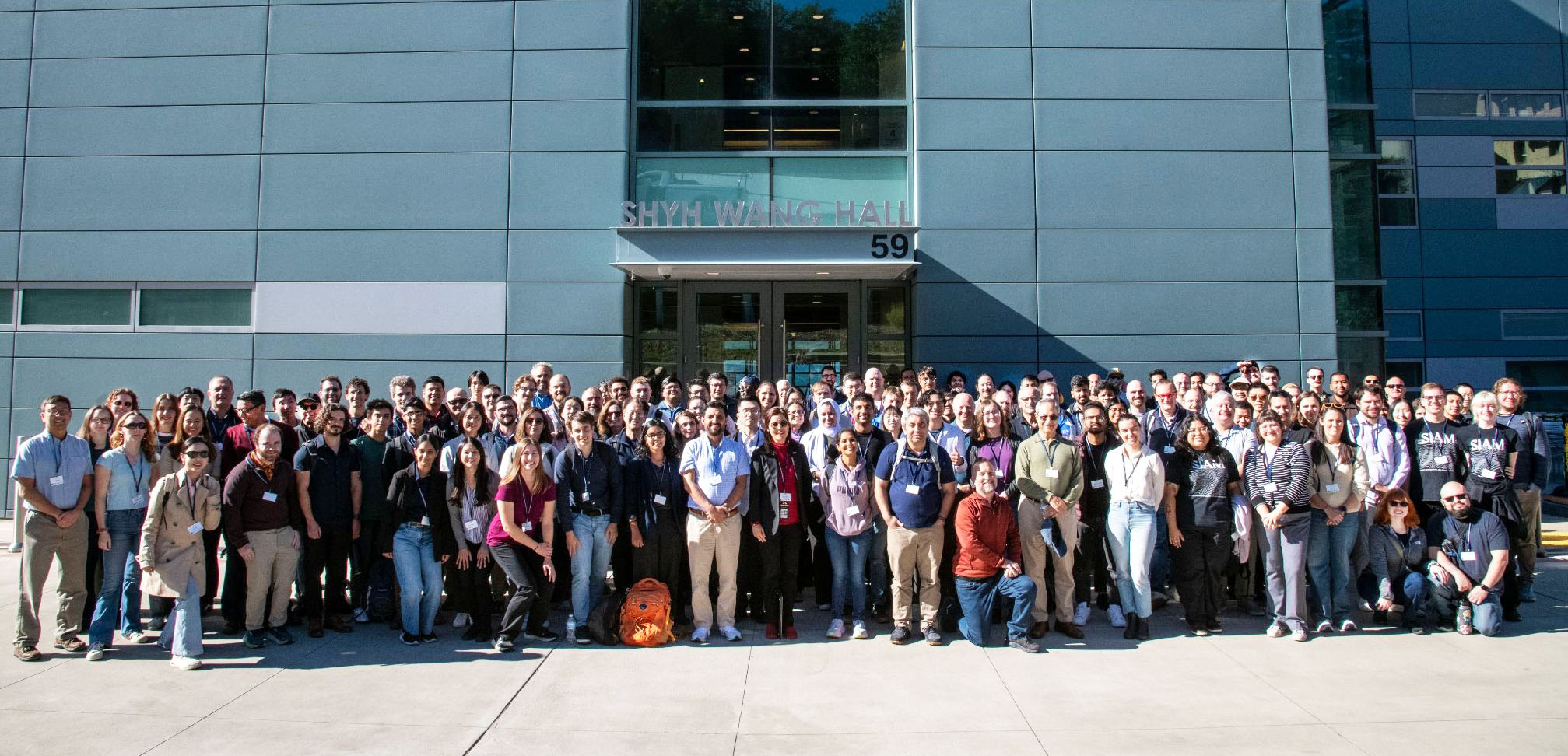
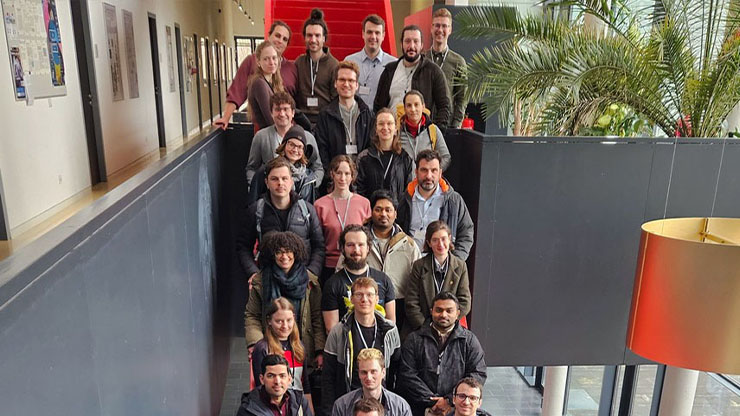
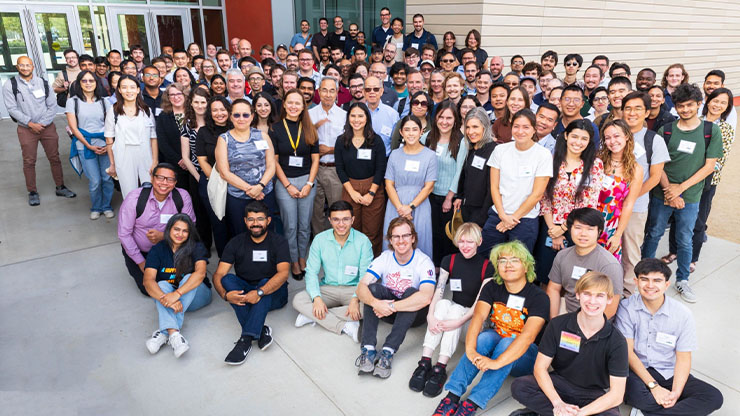
This two‑day gathering attracted more than 200 participants who ranged from high school, undergraduate, and graduate students to postdoctoral fellows, faculty members, laboratory scientists, and industry engineers. While the event primarily catered to the NCC community, the robust program drew presenters and attendees from across the U.S., as well as a few international scholars.
NCC25 opened with a plenary address by Robert Falgout of Lawrence Livermore National Laboratory (LLNL), who offered a state‑of‑the‑art overview of multigrid methods for extreme‑scale scientific computing. Falgout highlighted recent algorithmic breakthroughs that enable scalable solvers on exascale architectures and set the tone for the meeting’s technical prowess. The next day’s plenary by Suzanne Sindi of UC Merced explored the use of mathematical models as discovery tools in complex biological systems. Her talk combined multiscale modeling and uncertainty quantification to illuminate biological processes that span many orders of magnitude in space and time.
Beyond the plenary lectures, the program included 40 additional talks—organized across eight thematic sessions—that were selected by the Technical Program Committee through an open solicitation. The committee consisted of Shima Alizadeh of Amazon Web Services, Anthony Austin of the Naval Postgraduate School (NPS), Harun Bayraktar of NVIDIA, Bert Debusschere of Sandia National Laboratories, Alyson Fox of LLNL, Serkan Hosten of San Francisco State University, Tamara Kolda of MathSci.ai, Dongwook Lee of UC Santa Cruz, Vivek Pallipuram of the University of the Pacific, and Andy Wan of UC Merced. The thematic sessions comprised the following topics:
- High performance computing (HPC) and simulation of complex dynamical systems, which showcased advances in vortex‑method simulations, high‑order time integrators for cloud microphysics, and hierarchical reconstruction methods for real-time synchrotron tomography.
- Uncertainty quantification and data‑driven modeling, with talks that addressed interpolation‑model error bounds, multi-fidelity Bayesian optimization, determinant‑free Gaussian process regression, and sub‑Gaussian mean estimation.
- Machine learning for scientific computing (in two parts), where speakers introduced statistics‑informed neural surrogates, convolution‑only deep networks for phase‑field extrapolation, reinforcement‑learning‑guided tuning of atmospheric models, and geometry‑aware rational neural networks.
- Linear algebra and numerical methods, which covered tensor‑eigenvalue subspace projections, weight‑matrix analysis of implicit neural networks, column subset selection via nuclear scores, and multigrid methods.
Scientific computing for life sciences, which emphasized the growing demand for quantitative tools in biology and medicine. - Computational methods for partial differential equations (PDEs), with lectures that spanned turbulent flux algorithms, advection and diffusion, and dispersive hydrodynamic models.
- Control theory and system optimization, where presenters spoke about optimal control and collaborative autonomy, decentralized and PDE-constrained optimization, and fault-tolerant Kalman filtering.
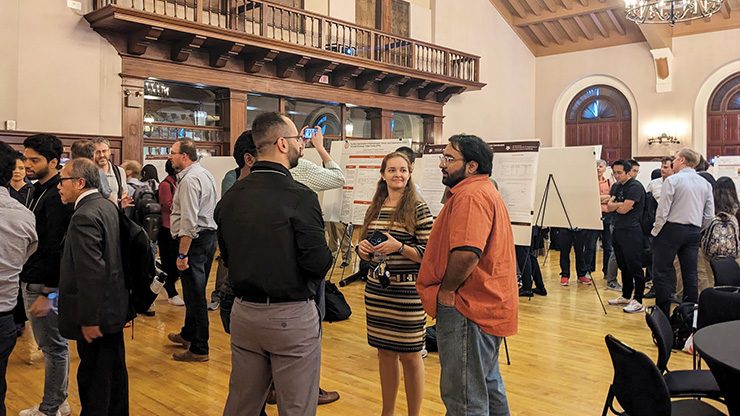
In addition to the many talks, conference attendees enjoyed 44 posters—highlighted through a plenary poster blitz—during two interactive poster sessions. Judges scouted both sessions and awarded best poster awards to Alexander Aghili of UC Santa Cruz, Jonathan Forstater and Kelli Gutierrez of UC Davis, Irabiel Romero of UC Merced, and Larry Wigington of NPS.
Moreover, two panel discussions connected the technical program to broader career prospects. During the first panel, Kolda, Alizadeh, Michael Mahoney of LBNL, and Habib Najm of Sandia pondered the role of artificial intelligence and large language models in reshaping research workflows, reproducibility, and the dissemination of scientific knowledge. The second panel—titled “Challenges in Mentoring Early‑career Professionals”—featured Sindi, Bayraktar, Falgout, and Ann Almgren of LBNL, who shared advice on mentorship, networking, and career transitions. Their session, which targeted more established researchers, was held concurrently with an interviewing and resume workshopping event for students and junior scientists. Bill Cannan, Senior Human Resources Division Partner at LBNL, reviewed interview strategies with attendees, who then broke into small groups for roundtable feedback on their CVs and resumes. Lively participation in both the panels and workshop reflected attendees’ strong appetites for practical professional development guidance alongside technical content.
To maximize the use of its location, NCC25 offered tours of two national user facilities at LBNL. Participants visited the National Energy Research Scientific Computing Center—a flagship HPC facility that hosts the Perlmutter supercomputer—and the Advanced Light Source, a cutting‑edge synchrotron‑radiation facility on LBNL’s campus.
Support from the U.S. National Science Foundation (NSF) provided funding for more than 60 travel awards for students and early-career professionals in the NCC region. These awards, which allowed for significant attendance from local scientists, were a highlight for the Local Organizing Committee and NSF support principal investigators Roel Van Beeumen, Aydın Buluç, Hannah Klion, Lin Lin, Paul Lin, Dmitriy Morozov, Per-Olof Persson, James Sethian, and Erika Ye (all of LBNL).
Looking ahead, the NCC Section of SIAM hopes to continue the momentum from its first two meetings with NCC26, which will take place at UC Davis in October of this year.
References
[1] Petra, N., & Marcia, R. (2021, January 21). Northern and Central California Section of SIAM holds inaugural conference. SIAM News, 58(1), p. 12.
About the Authors
Sherry Li
Senior scientist, Lawrence Berkeley National Laboratory
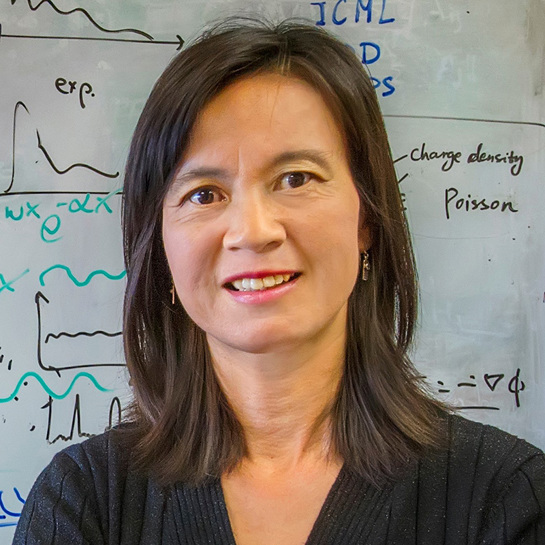
Sherry Li is a senior scientist and leader of the Scalable Solvers Group in the Applied Mathematics and Computational Research Division at Lawrence Berkeley National Laboratory.
Andy Nonaka
Staff scientist, Lawrence Berkeley National Laboratory
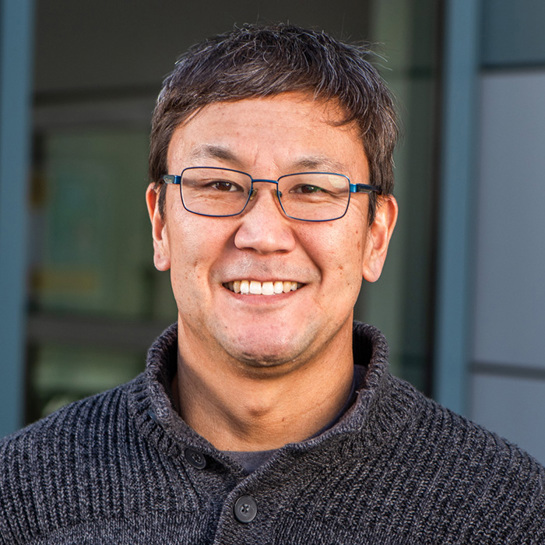
Andy Nonaka is a staff scientist and group lead of the Center for Computational Sciences and Engineering in the Applied Mathematics and Computational Research Division at Lawrence Berkeley National Laboratory.
Stefan M. Wild
Senior scientist, Lawrence Berkeley National Laboratory
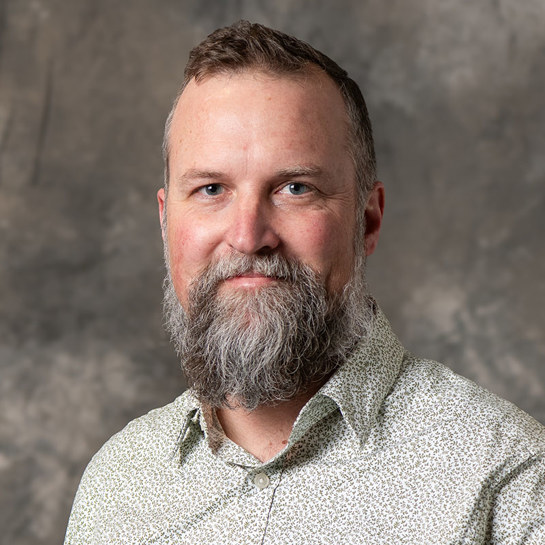
Stefan M. Wild is a senior scientist and director of the Applied Mathematics and Computational Research Division at Lawrence Berkeley National Laboratory. His website is https://wildsm.github.io.
Stay Up-to-Date with Email Alerts
Sign up for our monthly newsletter and emails about other topics of your choosing.