
The Multifaceted Benefits of Community Engagement in Industry and Academia
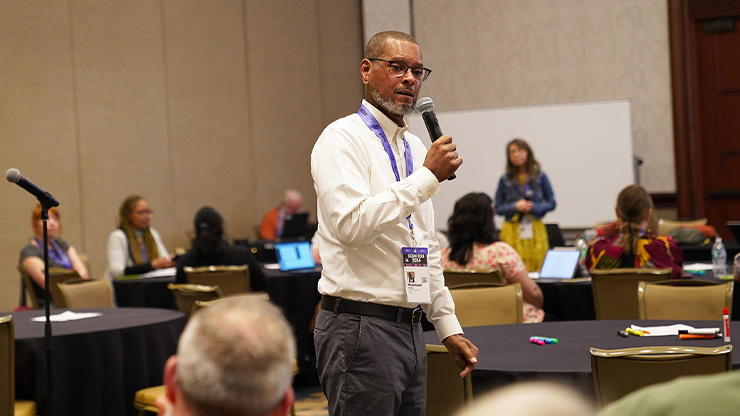
At the Third Joint SIAM/CAIMS Annual Meetings (AN25), which took place last summer in Montréal, Québec, Canada, a minisymposium session titled “Community Engagement in Mathematics: What? Who? How?” brought together applied mathematicians from a variety of fields to spotlight the growing movement toward outreach, collaboration, and public engagement in science, technology, engineering, and mathematics (STEM). The session, which was organized by the SIAM Education Committee, highlighted diverse programs that connect professional mathematicians with students, educators, and industry partners — ultimately demonstrating that community engagement enriches both individual participants and the discipline as a whole.
In addition to more traditional research and teaching responsibilities, mathematicians play an important role in promoting enthusiasm and correspondence with the general public. For instance, heightened engagement in schools and local communities can spark student curiosity, broaden societal understanding of mathematics’ critical contributions to real problems, and foster social responsibility. These types of initiatives strengthen ties between academia, industry, and society, ensuring that applied mathematics remains dynamic, relevant, and inclusive in the present day.
Kathleen Kavanagh of Clarkson University opened the AN25 session by discussing the surprising bridges between academia and industry that result from sustained community engagement. At Clarkson—a small, STEM-focused institution in rural New York—outreach programs for K-12 schools have become powerful platforms that build relationships with local businesses and research partners. By involving faculty, industry professionals, and school districts in collaborative projects, these efforts provide mutual benefits for all parties; students have the opportunity to witness the real-world applications of math, faculty form new research pathways, and local companies connect with the next generation of problem solvers — some of whom may become future employees.
Kavanagh, who serves as director of Clarkson’s Institute for STEM Education, also addressed practical challenges like funding and sustainability and offered strategies for getting started. Her talk underscored outreach’s ability to drive mathematical innovation while simultaneously delivering broad social impact. One such example showcased the high schoolers of Harrisville Central School District: a small, rural district in New York with a typical graduating class size of only 15-20 students. Due to local university support, mentorship, and access to laboratory space, a team of dedicated students was able to take part in a prestigious national research challenge. The group’s experiment was so successful that it was sent to the International Space Station, and participating students and their teacher traveled to Florida to view the launch of SpaceX CRS-26 in November 2022. The entire town celebrated this life-changing achievement, and two of the women on that team are now aerospace engineering majors.
Karen Bliss, then Senior Manager of Education and Outreach at SIAM, next introduced a mathematics program for middle school students, which resulted from a three-year experiment on a regional math modeling outreach day that quickly became a local tradition. Each year, seventh- and eighth-grade students from local schools are invited to Virginia Military Institute (where Bliss used to teach) to tackle open-ended math problems that require creativity, teamwork, and critical thinking. Bliss walked through the logistics of the program’s creation—from the initial planning stages to final execution—and reflected on the overwhelmingly positive feedback from students and teachers alike. In fact, students often ask for more time to continue working on their assigned problem. At the end of the day, they share their solutions and leave with a richer understanding of math’s copious problem-solving applications to complex, tangible issues — a distinction from many testing and classroom environments. Furthermore, the program’s modest cost and adaptable structure should make it relatively easy to launch at other colleges and universities across the country; simply think of a modeling problem, identify some relevant math (e.g., data and equations), and let the students explore!
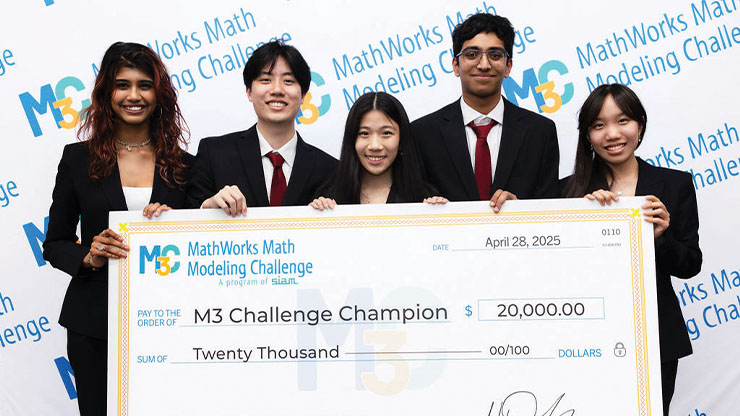
Bliss then overviewed the popular MathWorks Math Modeling Challenge (M3 Challenge): a program of SIAM with MathWorks as its title sponsor. Now in its 21st year, the annual internet-based competition engages thousands of 11th- and 12th-grade students across the U.S. and sixth form students in England and Wales. There are no registration fees, and participating teams of three to five individuals have 14 consecutive hours to address a multifaceted mathematical modeling prompt and produce a 20-page report that justifies their findings. After a triple-blind judging process, the top finalist teams travel to New York City to present their solutions to a panel of judges and compete for more than $100,000 in scholarship funds.
Unlike many traditional math competitions, M3 Challenge prioritizes real-world problem solving, teamwork, and data analysis. Teachers benefit from free resources and professional development, while students gain exposure to applied mathematics in a wide variety of contexts — from sustainability to public health. Bliss explained that M3 Challenge helps to demystify applied math by positioning it as a creative, vital tool that encourages students to contemplate and tackle pressing global issues. The following comments from coaches demonstrate the contest’s long-lasting takeaways and deviation from normal classroom-based mathematics education:
Please continue the M3 Challenge — our civilization needs this! Our kids are pressured excessively about grades, grades, grades, testing, testing, testing, standards, standards, standards, at the expense of intellectual curiosity and mathematical applications.
Challenge Weekend gives these youngsters an opportunity to experience working as a team for what is sometimes a stressful time period, and they learn a lot about themselves, perseverance, dealing with frustrations, and not being able to just look up the answer or ask a teacher. It is a wonderful opportunity!
Feedback from students provides further motivation for the continued development and implementation of these types of outreach programs:
I like that the prompts are centered around societal issues. It helps us understand/get a glimpse of what professionals must do to find solutions to the issues we face every day.
The whole concept of solving one problem as a group and the question itself were very engaging. It also recreates a job environment where we will have to communicate with other people to solve problems, which is certainly a valuable experience.
Despite being involved in many extracurriculars and academic competitions, M3 Challenge has easily been my favorite. The problems are exactly the types of questions I would love to ponder simply for their own sake, and I think [they] are actually designed extraordinarily well in the way they give just enough information to create a jumping off point, but not enough so as to restrict creative freedom.
One true advantage of M3 Challenge and the associated support system is its ability to showcase mathematics as an extracurricular activity, not just something to check off to earn a diploma. By providing a system where teachers and students can interact with math outside of the classroom environment, the contest changes the dynamic of the discipline at a critical stage for budding mathematicians. In fact, many participants go on to study mathematics or related STEM fields in college.
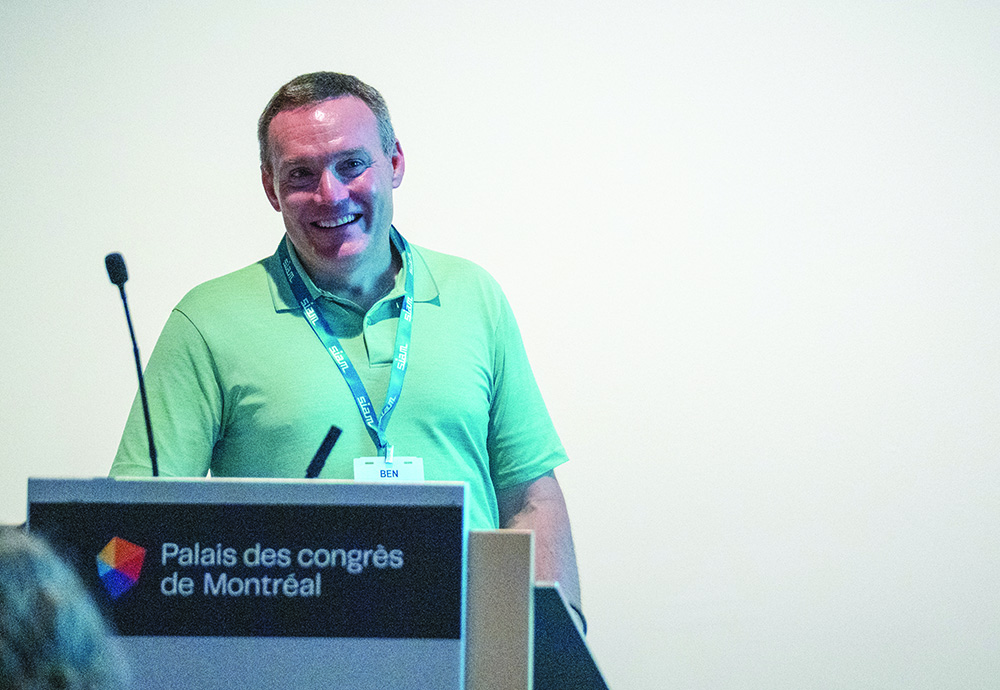
To close out the AN25 session, Benjamin Galluzzo of the Consortium for Mathematics and Its Applications (COMAP) spoke about COMAP’s efforts to engage students of all ages in mathematical modeling. COMAP hosts several major contests, including the High School Mathematical Contest in Modeling (HiMCM) and Middle Mathematical Contest in Modeling (MidMCM). These international events challenge teams of three or four students to devise mathematical models for open-ended questions. Galluzzo noted that the real growth comes not just from the competition itself, but through mentorship, structured preparation, and post-contest reflection. By working with teachers, mentors, and community partners, students build confidence, hone their communication skills, and exhibit resilience — key attributes that extend well beyond mathematics.
At the end of the session, the presenters affirmed that the pathways towards community engagement are numerous and accessible. They reminded the audience that such efforts cultivate future problem solvers while strengthening the discipline’s connections to society at large. SIAM plays a significant role in supporting these efforts through initiatives like M3 Challenge, SIAM Undergraduate Research Online, virtual and in-person career fairs, and numerous early-career programs for our members at conferences and via webinars. We encourage you to get involved by joining the SIAM Activity Group on Applied Mathematics Education or otherwise volunteering your time to support the next generation of applied mathematicians.
About the Authors
Kathleen Kavanagh
Professor, Clarkson University
Kathleen Kavanagh is a professor of mathematics at Clarkson University.
Lea Jenkins
Professor, Clemson University
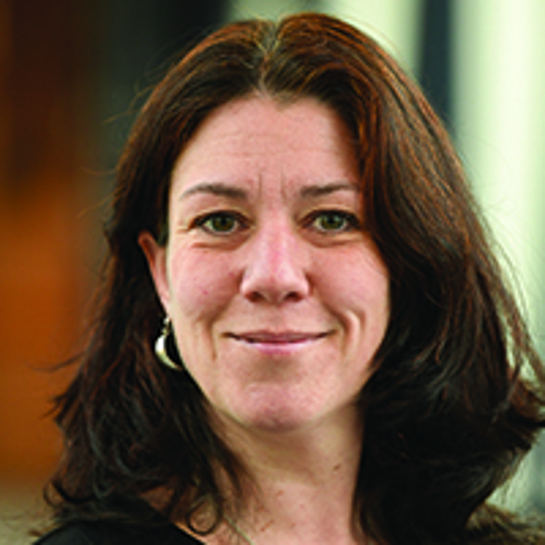
Lea Jenkins is a professor in the School of Mathematical and Statistical Sciences at Clemson University, where she works on modeling and simulation problems with industrial applications. She holds a Ph.D. in mathematics from North Carolina State University and is the Vice President for Education at SIAM.
Related Reading
Stay Up-to-Date with Email Alerts
Sign up for our monthly newsletter and emails about other topics of your choosing.