Undergraduate Mathematics Without Coercion?
In the spring of 2025, I taught my last mathematics class at Tufts University before retiring. It was an unusual course. Here, I will describe the course and the underlying thinking.
We teach mathematics at the college level for two reasons. First, scientists and engineers need mathematics in their professions. Second, mathematics is good for the soul in the same way in which novels, poetry, music, paintings, and walks in the woods are good for the soul. These reasons, which one might call “applied” and “pure,” often overlap. Mathematics is both useful and beautiful.
Unfortunately, students don’t always want to do what we think is best for them. In response, we sometimes try to motivate them with threats — bad grades, a failed exam, lost career opportunities. I have come to believe that this sort of coercion undermines both purposes of mathematics teaching. Students who learn under duress are unlikely to make creative use of mathematics in their future professional lives in science and engineering, nor will they enjoy mathematics as an art. Coercion is “destructive to our proper business,” as the composer John Cage said about value judgment in music. In March of 2025, I gave a Tufts TEDx talk on these thoughts. For the last course of my teaching career, I decided to try to put them into practice.
Because it was my last course, our department chair allowed me to teach whatever I wanted. I gave my course the vague title “Useful and Beautiful Topics in Undergraduate Mathematics.” Instead of a single overarching subject, I chose a new topic each week, sometimes connected to previous topics, other times not. Subjects included Platonic solids, including dimensions higher than 3; Bayesian statistics and what exactly “Bayesian” means; entropy and what motivates its definition; the “hairy ball theorem,” which is why fusion reactor designs are torus-shaped and not spherical; why we divide the octave into 12 steps (the second-smallest good number is 19); and why an election can never be organized so that “strategic voting” becomes impossible. There was a total of 12 topics altogether, with the 13th week devoted to a few more minutes of review and new content on each of the 12 topics. I tried to choose topics that I consider important, but that many undergraduate mathematics majors may never learn about. I shared my notes with the students; they look like a book now.
Each week, I gave a 75-minute lecture on the week’s topic, followed by a 75-minute discussion class during which the students worked together—often on the board—on a list of questions and problems. There were no exams and no obligatory homework, but I did distribute long lists of problems each week, often publishing solutions as well; all of this material is included in the class notes. From the start, I promised an A for regular attendance and participation in good faith — only a very mild form of coercion!
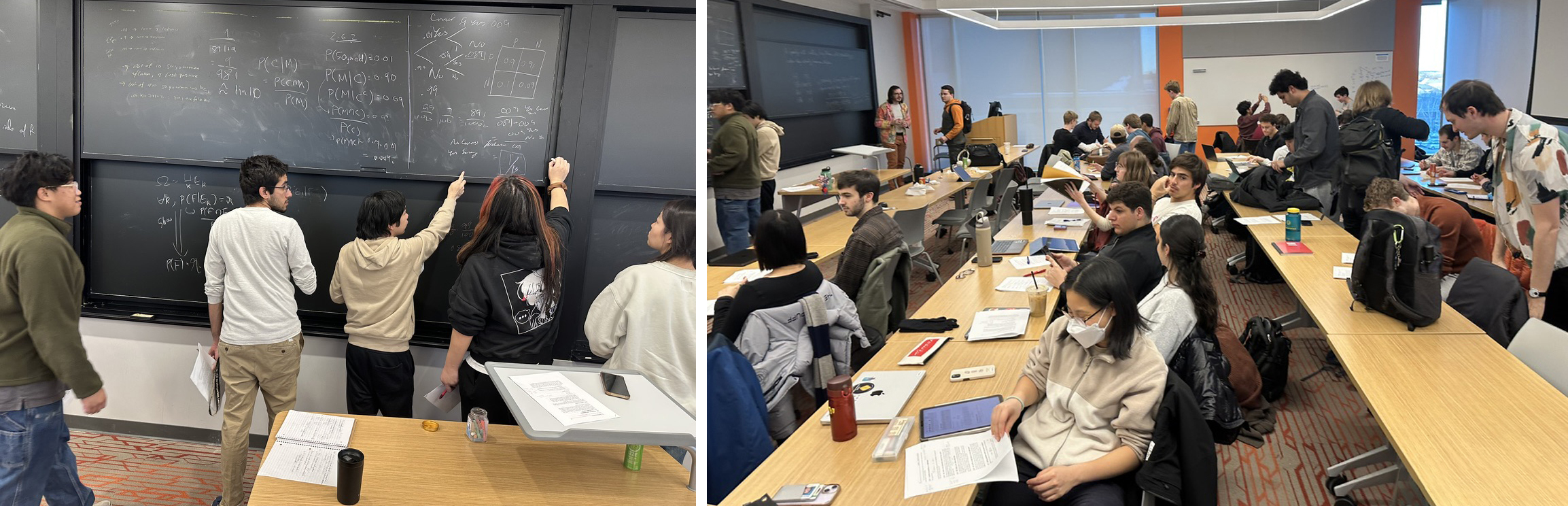
It all worked better than I had any right to hope, and I felt good about giving an A to each of my 52 students, mostly mathematics majors ranging from a very strong first-year undergraduate to an outstanding 5th year Ph. D. candidate — all of whom remained cheerfully and enthusiastically engaged throughout the semester. It was a wonderful end to my teaching career.
Nonetheless, I am not entirely satisfied with this experiment. In hindsight, I believe I went too far; a little bit of friendly coercion might have helped many students learn more. Teachers aren’t drill sergeants, but they should act like fitness coaches, helping students find the discipline to do what they want to do. If I taught the course again, I would ask the students to keep a record of everything they do for the class in the form of a handwritten physical notebook and show it to me once every two weeks. I would critique the journals and be prepared to give low grades for low engagement. For that to be practical, there would need to be far fewer than 52 students! And I would still not tell the students what they have to do and focus on for no better reason than “it has been assigned.”
At the end of the semester, I told my students that there was a final exam after all, consisting of the following four questions to be answered 15 years from now:
- Are you still interested in mathematics?
- Do you use it in creative ways?
- Do you read about it for pleasure?
- Do you still know why mathematics is good for the soul?
There are many excellent resources that can help a former mathematics major remember the pleasures of the subject, even 10 or 20 years after graduation. Examples that I happen to know and am fond of include Grant Sanderson’s 3Blue1Brown YouTube channel; The Mathematical Gazette; the Mathematics Magazine; The Mathematical Intelligencer; books such as Sync by Steven Strogatz, The Spirit of Mathematics by David Acheson, or How Not to Be Wrong by Jordan Ellenberg; and of course many articles in SIAM News.
Throughout my years of teaching, I did far too little to make my students aware of resources of this sort. I am trying to make up for it now by keeping a list on my webpage, hoping that some people will find it helpful.
The title of this article ends with a question mark because I am not sure. Not all mathematics courses can be taught in this style. But I do think it’s good for an undergraduate mathematics major to take a course in this style once at least.
About the Author
Christoph Börgers
Professor emeritus, Tufts University
Christoph Börgers is a professor emeritus of mathematics at Tufts University. He holds a Ph.D. from the Courant Institute of Mathematical Sciences at New York University.